
connect-n-rejuvenate.com · Building Connection · Family
Celebrating the desi mother’s unspoken love language — and the guide to finally saying it back. For Mother’s Day and every day after.
She never said it directly.
Not in so many words.
Not the way they say it in films or greeting cards or the WhatsApp forwards she sends you every morning without fail.
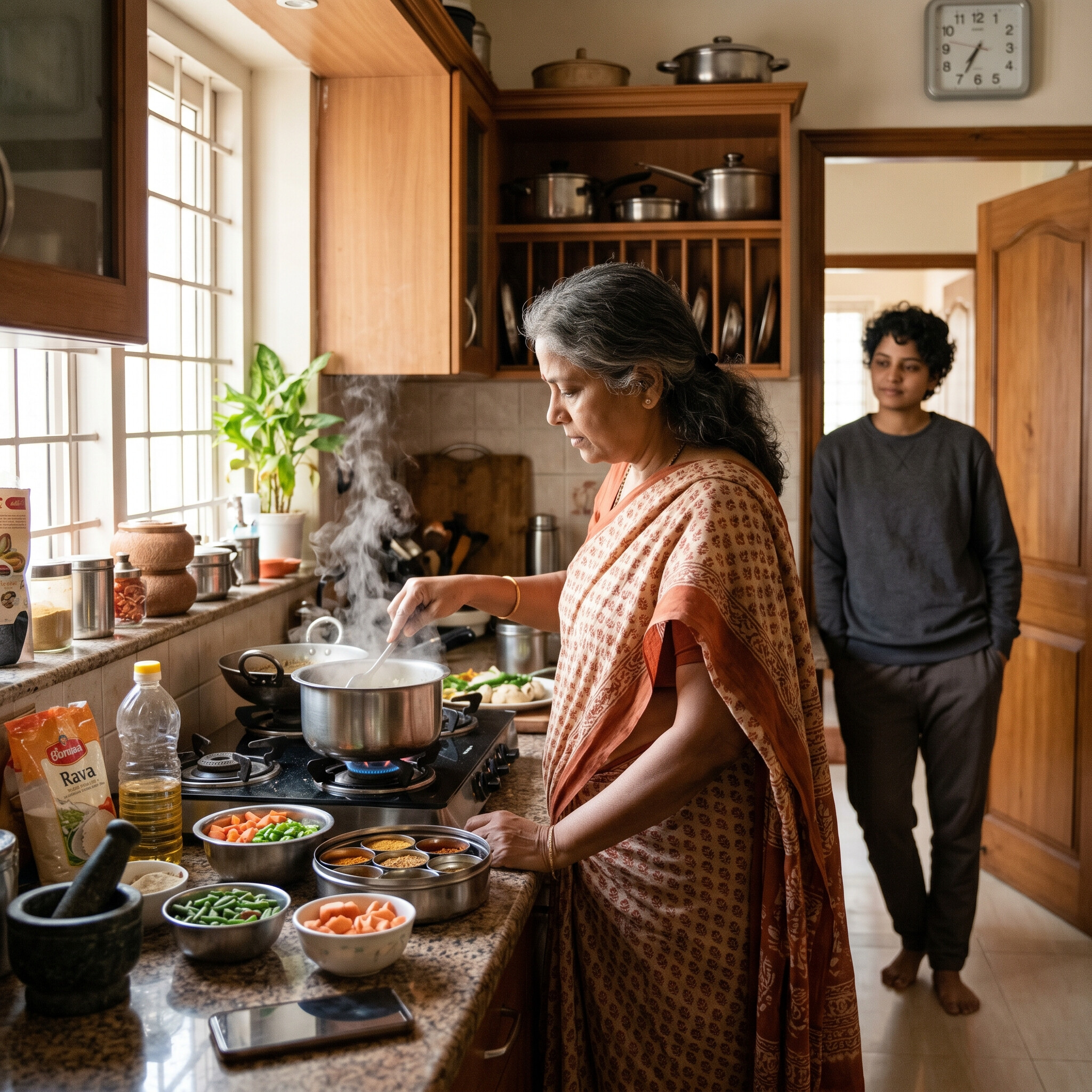
But she was awake before everyone else.
Making sure there was hot food before you left the house.
She remembered every exam date. Every interview. Every appointment.
Even the ones you forgot to tell her about.
She pressed extra money into your hand when you were leaving.
Then pretended she hadn’t.
She said “I love you” every single day.
She just never used those words.
This is the story of the desi mother’s love language. And this is your guide to finally saying it back.
“She said ‘I love you’ in early mornings and steel dabbas. In WhatsApp forwards and prayers said quietly for someone who doesn’t know. In a lifetime of showing up — in every way except the one we were taught to recognise.”
The Desi Love Language — In Six Cards
South Asian mothers have always expressed love through action, not declaration.
It is a different grammar of love. Just as rich. Just as real.
We just were never taught to read it.
?
Food as devotion
She researched Indian grocery stores in your city before you moved there.
“Have you eaten?” is not a question. It is I love you in a different language.
?
The WhatsApp forward
The morning prayer. The health tip. The random video she thought you’d like.
Each one says: I was thinking of you before I did anything else today.
?
The prayer you didn’t know was happening
She has been praying for you every single day.
For your health, your marriage, your children, your safety on flights.
→ Light a diya in her prayer corner — a gift that honours what she does every morning for you
?
The money pressed into your hand
“Take it. Just in case.” Then she changed the subject so you couldn’t argue.
She always gave more than she could spare.
?
Waiting up
She tracked your flight on her phone and did not sleep until it landed.
She called the exact moment you arrived. Every single time.
?
The practical worry
“Have you got a jacket? Are you drinking enough water?”
What sounds like nagging is a running inventory of your wellbeing. Maintained always. With love.
Reading these as love — really reading them — changes everything.
It shifts the whole texture of the relationship.
And it starts with deciding to translate, rather than waiting for the language to change.
What Goes Unspoken — And What It Costs
The desi love language is powerful.
But it has a gap. And that gap has a cost.
When love is expressed through doing and rarely through saying —
certain things stay permanently unspoken.
The “I am proud of you” that was felt but never said.
The “I am sorry for the pressure” that lived in changed behaviour but never in words.
The “you mean everything to me” that your mother has felt every day of your life.
And on your side — the things you have never said either.
The gratitude that only became visible in adulthood.
The “I understand now why you did that.”
The “I see you” that every mother needs to hear.
For NRI and long-distance families
When you are in a different country, she cannot love you the way she knows how.
She cannot cook for you. Press money into your hand. Wait up to hear your key in the door.
And you cannot show up the way you know how either.
What remains is the gap — and neither of you has quite the language to bridge it. Mother’s Day is your permission to try.
Mother’s Day gives you a culturally sanctioned moment to say what might otherwise wait forever.
The question is what to actually say.
And how to say it in a way that feels true — not borrowed from a Hallmark card.
Finally Saying It Back
Expressing love to a South Asian mother does not always come naturally.
Many of us inherited the same communication gap we are trying to close.
That is not a reason not to try. It is a reason to try more intentionally.
Start in her language, then offer yours
Begin with something she recognises as love.
→ Something small that will make her smile every morning
Cook with her. Sit with her. Show up without being asked.
From there, begin to offer your language — a card, a spoken acknowledgment, a memory named out loud. Both together tend to land in a way that neither alone would.
Be specific, not general
She has heard “you do so much for us” her entire life.
What she has rarely heard is the specific thing.
The particular moment. The exact sacrifice. Named and acknowledged.
“Not ‘thank you for everything’ — but the exact moment, named and held up to the light. That is the most powerful gratitude there is.”
Say it back — five conversation starters
Not scripts. Starting points.
Real things that real desi adult children have wanted to say and found hard to begin.
For the gratitude that was never said
“I have been thinking about everything you gave up to give us the life we have. I do not think I ever properly acknowledged it. I am acknowledging it now.”
For the love that always went unspoken
“I know you have always shown me you love me — in the food, in the worry, in everything you do. I want you to know that I see it. I have always seen it. And I love you too.”
For NRI and long-distance families
“Being far from you is the hardest part of the life I have built here. Not a day goes by that I do not think of you. The distance is not indifference. You are with me everywhere I go.”
For the pressure that was always love in disguise
“I understand now that the expectations came from wanting the best for me — that they were a form of faith in what I could be. I did not always see it that way. I see it now.”
For the mother who did not have it easy
“I have been thinking about everything you carried — what you gave up, what you never complained about. You deserved more support than you got. We are still learning how to give it. But we see you.”
Celebrating Maa From Across the World
For diaspora families with mothers back home —
you cannot show up at her door. You cannot cook together or sit beside her at the mandir.
The love is as strong as it has ever been.
But the usual ways of expressing it are not available.
Here is what actually works across the distance:
- Send something before the day. A gift that lands early tells her you were thinking of her before the occasion reminded you to.
- Schedule a call that is only for her. Not a family call. Just the two of you. Ask her something real — how she is actually doing, what she misses.
- Record something she can keep. A voice note, a video message, the specific things you want to say — that she can return to on the ordinary days when she misses you most.
- Involve the grandchildren. Have them draw something, say something, sing something. Nourishing that relationship across the distance is a gift to everyone.
- Say the thing you have been meaning to say. The occasion gives you permission. Use it.
For the Desi Mother Reading This
If your child shared this with you — that is already a small act of love.
It means they are thinking of you, even if they have not yet found the words.
“The meals made before anyone asked. The prayers said in the dark. The worry carried alone so no one else had to. That is not small. That is a life given over to the people you love.”
You are allowed to need things too.
You are allowed to tell your children what you miss. What you need. What would make you feel seen.
Asking for things does not make you a burden. It makes you human.
If there is something you have wanted to say to your children —
the pride, the love that goes without saying but perhaps should be said —
this is as good a moment as any to begin.
Seva and self
Seva is beautiful. And seva does not require silence about your own needs.
The most powerful thing a desi mother can model is not only how to give — but how to receive. How to ask. How to be known.
Your children are watching everything you do. Show them what it looks like to love yourself as generously as you love them.
When It’s Complicated
Not every mother-child relationship in a South Asian family is warm and uncomplicated.
Some carry real hurt. Patterns of criticism. Emotional distance. Expectations that were never quite achievable.
If that is your experience — this article is for you too.
Complicated love is still love.
Mother’s Day does not require you to perform a closeness you do not feel.
It offers a quieter invitation: to acknowledge what was given — even imperfectly — alongside what was hard.
Both things can be true at the same time.
A small gesture that feels true to where you are is enough.
Showing up at all — in whatever way you can manage — is its own form of love.
Quick Answers
My mum says “don’t get me anything” — does she mean it?
Almost certainly not entirely. It means: don’t go to trouble for me. It does not mean: your presence and your words are unwanted. Show up. Sit with her. Say something real. That is almost always what she actually wants.
We have never been verbally affectionate. How do I start?
Start in her language first — cook with her, sit beside her, show up without being asked. From that foundation, introduce words gradually. A card. A voice note. One specific memory named out loud. It does not have to be sudden. Gentle and gradual still counts.
My maa is in India and I’m abroad. How do I make her feel celebrated?
Send something before the day so she knows you planned it. Schedule a video call that is only for her — no distractions, just presence. Record a message from you and the grandchildren she can keep. And say the specific thing you have been meaning to say. This is the right moment.
What if my relationship with my mother is painful?
You do not have to resolve everything today. A small gesture that feels true to where you are is enough. If you need support navigating a complicated relationship, a culturally competent therapist who understands South Asian family dynamics can help.
How do I honour my mother if she has passed away?
Cook her signature dish. Visit a place that was meaningful to her. Light a diya. Tell her grandchildren a specific story about her. Write her a letter with what you would have said. She is still worth celebrating. You are still allowed to speak to her.
The Most Important Thing You Can Do This Mother’s Day
It is not the gift.
It is not the flowers, the restaurant, or the card with the pre-written message.
It is the specific, true, personal thing that only you can say to her.
Because only you know her in exactly the way you do.
Think of one thing she did that you have never properly acknowledged.
One sacrifice you only understood later.
One moment where she showed up in her quiet, desi way — and you received it without fully knowing what it was.
Tell her about that moment.
Name it. Give it back to her.
Let her know that it landed.
A gentle invitation
Think of one thing she did that you have never properly acknowledged.
When did you last reach out — not because you needed something, but simply to be with her?
What would it look like to say the thing you have been meaning to say — this week?
Connection does not require perfection. It requires only this: the willingness to reach toward her — and to let yourself be reached for in return.
“Beta, did you eat?” was never really about the food.
It was always about: I love you. I think of you. You matter to me more than I know how to say.
This Mother’s Day — say it back.
Mother’s Day 2026 is Sunday, May 10.
Filed under: Building Connection · Family · connect-n-rejuvenate.com
Leave a Reply