
Holi is more than just a festival of colors—it is a celebration of renewal, forgiveness, joy, and human connection. Marking the arrival of spring, Holi brings families, friends, and communities together to let go of the past and welcome new beginnings with laughter, music, and vibrant hues.
Rooted deeply in Indian mythology and cultural traditions, Holi has evolved into a global festival celebrated by people of all backgrounds. Whether you grew up playing Holi in India or are celebrating it abroad with loved ones, the essence remains the same: connection, rejuvenation, and shared happiness.
In this article, we explore the mythological origins of Holi, its cultural significance, and meaningful ways to celebrate Holi in today’s busy lives—while staying true to its soul.
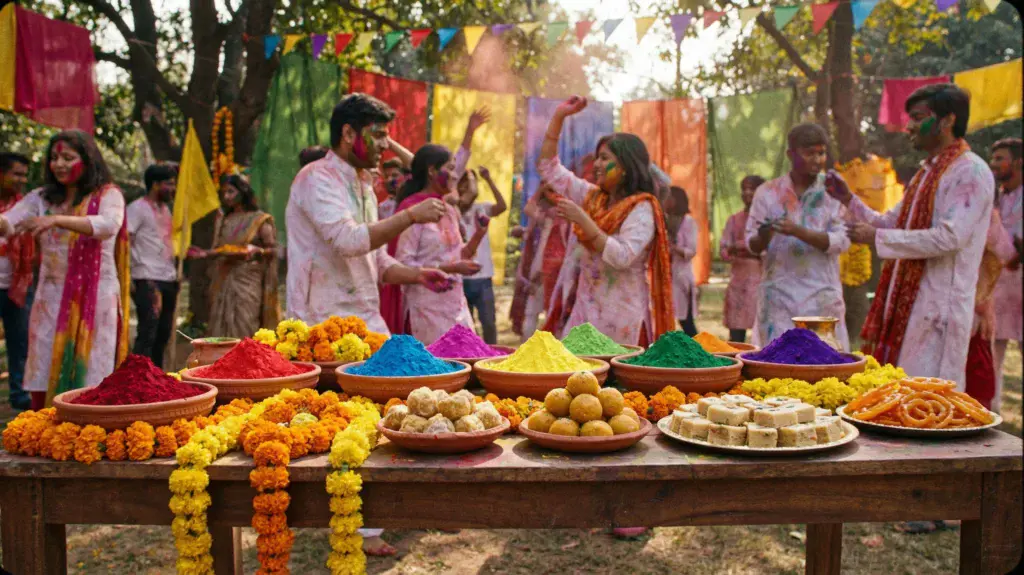
What Is Holi and Why Is It Celebrated?
Holi is a Hindu spring festival celebrated on the full moon day (Purnima) of the Hindu month of Phalguna, usually falling in March. It symbolizes:
- The victory of good over evil
- The arrival of spring after winter
- Renewal of relationships
- Joy, playfulness, and equality
On Holi, social boundaries dissolve—age, status, and differences fade as everyone comes together in celebration.
Traditionally, Holi is a two-day festival:
- Holika Dahan (the night before Holi)
- Rangwali Holi (the festival of colors)
The Mythological Stories Behind Holi
Holi is unique because it draws meaning from multiple mythological stories, each reinforcing its deeper values.
1. The Story of Prahlad and Holika: Triumph of Devotion Over Ego
One of the most well-known stories behind Holi is the legend of Prahlad, Holika, and King Hiranyakashipu.
Hiranyakashipu was a powerful demon king who demanded that everyone worship him as a god. However, his own son Prahlad was a devoted follower of Lord Vishnu. Enraged by Prahlad’s unwavering faith, the king attempted to kill him multiple times—but failed each time due to divine protection.
Finally, Hiranyakashipu asked his sister Holika, who had a boon that made her immune to fire, to sit in a blazing fire with Prahlad on her lap. However, the boon worked only if Holika entered the fire alone. As a result, Holika was burned to ashes, while Prahlad emerged unharmed.
🔥 Holika Dahan, celebrated the night before Holi, commemorates this event and symbolizes:
- The destruction of arrogance and evil
- The power of faith, truth, and righteousness
Source:https://www.britannica.com/topic/Holi-festivalhttps://www.templepurohit.com/significance-of-holika-dahan/
2. Krishna and Radha: Playfulness, Love, and Color
Another beloved legend of Holi comes from the life of Lord Krishna.
As a child, Krishna was upset about his dark complexion and wondered why Radha was so fair. His mother Yashoda playfully suggested that he apply color to Radha’s face. Krishna did so, and this playful act became a symbol of love, equality, and joyful mischief.
This story is especially celebrated in Vrindavan and Mathura, where Holi festivities last for several days with music, dance, and devotional fervor.
🎨 This legend represents:
- Love without boundaries
- Playfulness in relationships
- Acceptance beyond appearances
Source:https://www.iskcon.org/holi-krishna-radha/https://www.britannica.com/topic/Krishna-Hindu-deity
3. Shiva and Kamadeva: The Power of Transformation
In some traditions, Holi is also associated with Lord Shiva and Kamadeva, the god of love.
According to legend, Kamadeva tried to awaken Shiva from deep meditation by shooting his arrow of love. Shiva opened his third eye and burned Kamadeva to ashes. Later, Kamadeva was restored in a formless state, symbolizing the transformation of desire into spiritual love.
This story adds a philosophical layer to Holi—reminding us that inner renewal is as important as outward celebration.
Source:https://www.templepurohit.com/story-of-kamadeva/
Cultural Significance of Holi Today
Beyond mythology, Holi plays an important social and emotional role:
- Forgiveness: Old grudges are let go
- Equality: Everyone is the same under color
- Community bonding: Families, neighbors, and friends reconnect
- Joyful expression: Music, dance, and laughter bring emotional release
In modern life, where relationships often take a backseat to busy schedules, Holi offers a powerful reminder to pause and reconnect.
How Holi Is Celebrated Across India
Holi traditions vary by region, making it a richly diverse festival.
- North India: Large public celebrations, color play, bhang, music
- Vrindavan & Mathura: Lathmar Holi, temple celebrations
- West India (Gujarat & Maharashtra): Community gatherings, folk songs
- East India (West Bengal): Dol Jatra with cultural performances
- South India: More spiritual and symbolic observances
Each style reflects the local culture while honoring the same core values.
Simple and Meaningful Ways to Celebrate Holi Today
Not everyone wants loud crowds or messy celebrations—and that’s okay. Holi can be equally meaningful in quieter, intentional ways.
1. Host a Color-Themed Family Gathering
- Use eco-friendly colors
- Serve traditional sweets like gujiya or malpua
- Play soft Bollywood Holi songs
2. Create a “Forgiveness & Gratitude” Ritual
Invite family members to:
- Share one thing they’re grateful for
- Let go of one past misunderstanding
This aligns beautifully with Holi’s spiritual meaning.
3. Celebrate Holi with Kids (Mess-Free)
- Color crafts
- Storytelling about Prahlad or Krishna
- Natural flower colors for play
4. Virtual Holi for Long-Distance Families
- Dress in white
- Share stories, photos, and memories
- Send digital greeting cards
Interactive Section: Reflect, Connect, Rejuvenate
Encourage readers to engage more deeply with the festival:
💬 Reflection Questions:
- What does “letting go” mean to you this Holi?
- Which relationship would you like to renew?
- What color best represents your current phase of life?
🎨 Family Activity Idea:Ask each family member to choose a color and explain what it represents for them—hope, calm, joy, courage.
Holi in a Global World
Today, Holi is celebrated worldwide—in the U.S., UK, Europe, and beyond—often as a cultural festival promoting joy, diversity, and unity.
For the Indian diaspora, Holi becomes:
- A way to pass traditions to children
- A bridge between generations
- A celebration of identity and belonging
Final Thoughts: The True Spirit of Holi
At its heart, Holi is not about how much color you throw—but how deeply you connect.
It reminds us that life is imperfect, colorful, and fleeting—and that joy multiplies when shared. Whether you celebrate Holi with a crowd or quietly at home, the festival invites you to renew relationships, release burdens, and embrace life with openness and love.
May this Holi bring color not just to your surroundings, but to your heart and relationships as well.