
“What will people say?” has silenced too many of us for too long. This is the warm, honest, culturally rooted guide to understanding what family connection really does for our mental health and how to start building it.
If you have ever walked through a painful season, a stretch of deep anxiety, a period where getting out of bed felt like climbing a mountain, a quiet grief that nobody around you could quite see, you may have noticed something. The people around you mattered more than almost anything else.
Not what they said. Not the advice they gave. Just their presence. The fact that they showed up. The fact that they stayed.
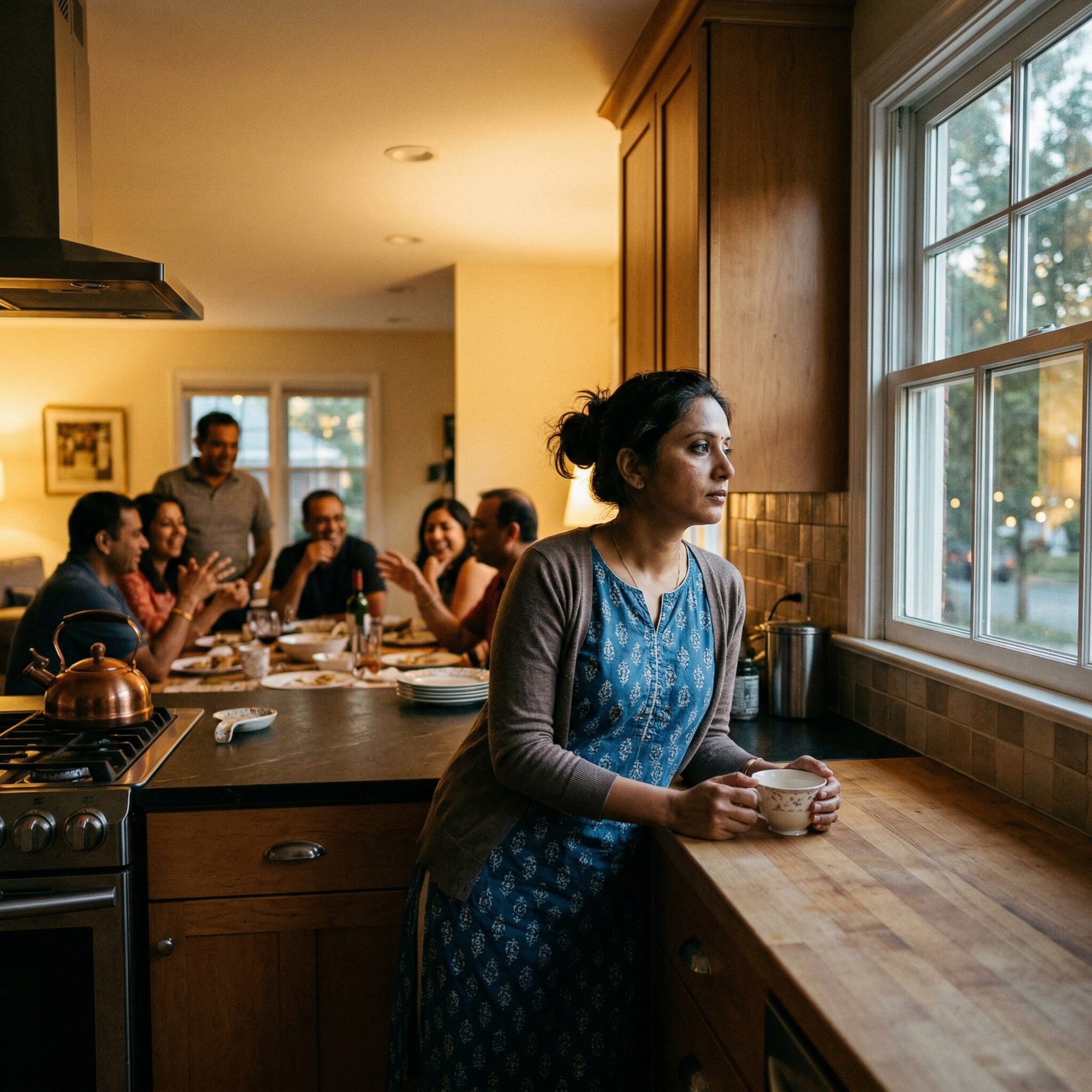
And yet in families across the Desi diaspora, there is a particular kind of silence that makes this kind of presence almost impossible to ask for. It is the silence that descends when someone is not doing well, and everyone in the family can sense it, but nobody says anything directly. Instead, more food appears. Practical advice is offered. Prayers are said. And the person who is struggling learns, often from a very young age, that some things are simply not spoken about.
Mental health is one of those things. And that silence is costing us more than we have been willing to admit. This article is about breaking it, not loudly, not confrontationally, but honestly. Because Desi families, with our deep roots in loyalty, seva, and showing up for each other, have everything we need to be each other’s greatest source of healing. We just need to learn how to use it.
“In desi families, love is rarely the problem. What gets in the way is the silence around struggle, the unspoken rule that strength means never letting anyone see you fall apart.”
The Silence Has a Name: Mental Health Stigma in South Asian Families
Let us name what is actually happening. Mental health stigma in Indian and South Asian families is not simply ignorance. It is a complex set of beliefs, shaped by generations of cultural conditioning, that makes acknowledging mental health struggles feel genuinely dangerous — to the individual, to the family, and to the community.
These beliefs tend to sound something like this:
WHAT GETS SAID
- “Log kya kahenge?” (What will people say?)
- “This is not depression, this is laziness.”
- “Just pray more. Have faith.”
- “In our family, we do not have these problems.”
- “Going to a therapist means you are mad.”
WHAT IT COSTS
A generation of South Asian adults carrying anxiety, depression, and grief completely alone, convinced that to speak would be to disgrace the people they love most. And a generation of parents who genuinely want to help, but were never given the language or permission to try.
A 2020 study published in the journal Transcultural Psychiatry found that South Asian communities report significantly higher barriers to mental health help-seeking than the general population and that family attitudes toward mental health were among the strongest predictors of whether someone sought support. In other words, what your family believes about mental health directly shapes whether you feel permitted to get help.
That is a significant responsibility. And it is also a significant opportunity, because it means that when families shift their attitudes, the impact on individual mental health is immediate and real.
WORTH SITTING WITH
The stigma is not a moral failing. It was passed down, generation to generation, by people who were themselves never permitted to struggle openly. Understanding this does not excuse the harm it causes. But it does mean that change is possible and often begins with one person in a family deciding to do things differently.
What Family Connection Actually Does for Mental Health
The relationship between family connection and mental health is not just emotional; it is physiological. When we feel genuinely supported by people we trust, our nervous system responds measurably. Cortisol — the primary stress hormone — decreases. Heart rate steadies. The body shifts from a state of threat to a state of safety.
The Harvard Study of Adult Development, one of the longest-running studies on human wellbeing ever conducted, tracking participants for over eighty years, found that the quality of close relationships was a stronger predictor of late-life health and happiness than wealth, fame, or even cholesterol levels. Not the number of relationships. Not how often people gathered. The quality, the depth of feeling known, valued, and safe.
For South Asian diaspora families, this research carries particular resonance and complications. Because on paper, desi families have so much of what the research says matters: deep loyalty, consistent presence, a cultural framework built around showing up for each other. And yet the mental health outcomes in our community tell a more complicated story.
The missing piece, almost always, is not the love. It is safety to be honest within it.
WHAT GENUINE FAMILY CONNECTION PROVIDES
- A regulated nervous system. Being in the presence of people who feel safe to us — genuinely safe, not performatively harmonious — physically calms the body. This is why a phone call from the right person can change the texture of an entire day.
- An anchor of identity. For South Asian diaspora adults navigating the particular exhaustion of living between two cultural worlds — too desi for one context, not desi enough for another — family connection can provide a grounding sense of who you are and where you come from. That anchor matters enormously for mental stability.
- Reduced shame around struggling. Being known by someone and still loved — especially in a family context where mental health struggles have historically been hidden — is one of the most quietly powerful healing experiences available. It dismantles the belief that you are uniquely broken.
- A pathway to professional help. Research consistently shows that people with strong family support are significantly more likely to seek professional help when they need it. A family member who says “I think you should speak to someone, and I will help you find them” can be the single factor that makes the difference between suffering in silence and beginning to heal.
- The texture of daily support. Mental health does not only live in therapy rooms or during crises. It lives in whether there is someone to call on a bad Tuesday. Whether someone notices you have gone quiet. Whether there is a person who will sit with you without needing you to explain yourself or perform recovery.
The Specific Weight Diaspora Families Carry
Desi family mental health in the diaspora carries pressures that are worth naming specifically, because they are rarely reflected in mainstream mental health conversations, and yet they are almost universal among our community.
THE EXHAUSTION OF BEING THE STRONG ONE
In many South Asian families, there is one person, often the eldest child, often a daughter, often the one who emigrated and is perceived to have “made it”, who becomes the family’s emotional anchor. They manage the problems. They translate between worlds. They hold things together. And they do it at an enormous personal cost, because asking for help feels incompatible with the role they have been cast in.
If this is you, this needs to be said clearly: being the strong one does not mean you are not allowed to struggle. It means you have been given an unfair amount to carry. Those are very different things.
“The person holding the family together is still a person. They need connection too, not as a provider of it, but as a recipient.”
LONG-DISTANCE FAMILY GUILT AND NRI MENTAL HEALTH
For NRI families, those who have built their lives abroad while parents, siblings, and extended family remain in India, the mental health dimension of distance is significant and rarely discussed. There is the guilt of not being there when a parent falls ill. The grief of missing funerals, weddings, and births. The slow erosion of the daily texture of belonging that used to come from simply being physically present in the same city as your family.
And there is the particular pressure of appearing to have everything together, because you are “the one who went abroad,” and admitting to struggling can feel like a betrayal of the sacrifice that made the journey possible.
IDENTITY AND THE SECOND GENERATION
For South Asian adults who grew up in Western countries, the mental health pressures of cultural identity are real and specific. The daily work of code-switching, being one version of yourself at home and another in the world outside, is genuinely exhausting. The experience of feeling not Indian enough for the family and not British or Australian or American enough for everyone else creates a particular kind of loneliness that is difficult to name and even harder to bring to a family that may not understand it.
FOR SECOND-GENERATION READERS
Your identity struggle is real. It is not ingratitude. It is not confusion. It is the entirely predictable result of growing up between two worlds that both have valid claims on you. You are allowed to find it hard. And you are allowed to ask your family to understand that even if it takes several conversations, and even if the first one does not go well.
For the Family Member Who Wants to Help
If someone in your family is struggling with their mental health, you may feel the pull of several instincts at once: to fix it, to minimize it, to offer practical solutions, to pray about it, to tell them they have so much to be grateful for. These instincts come from love. They also, in this context, tend not to help.
What actually helps, according to both research and the lived experience of people who have been supported through mental health struggles, is simpler and harder than any of those things. It is presence without an agenda.
PRACTICAL WAYS TO SHOW UP FOR A FAMILY MEMBER WHO IS STRUGGLING
- Ask the real question. “How are you?” invites a social answer. “How are you really doing?” — asked quietly, at the right moment, with genuine willingness to hear the actual answer — is an entirely different kind of question. Ask it. Then be still and listen.
- Resist the urge to reassure immediately. When a family member shares something painful, the instinct is often to quickly reassure them — “it will be fine,” “you are strong,” “think positively.” This, however well-intentioned, communicates that their pain needs to be resolved quickly rather than heard properly. Sit with what they have said first. Acknowledge it before you try to fix it.
- Do not make it about the community. “Log kya kahenge” has no place in a conversation about someone’s mental health. Full stop. If your first instinct when a family member opens up is to think about how it will look — notice that instinct, and consciously choose the person in front of you instead.
- Normalise professional support explicitly. Saying “I think you should speak to a therapist” is not enough in a community where the stigma around therapy remains significant. Going further matters — “I will help you find someone,” “I will come with you to the first appointment,” “speaking to a professional is the bravest and most practical thing you can do.” These specific, active statements can make the difference.
- Check in consistently, not just in the crisis. Mental health recovery is not linear, and it does not end when the acute crisis passes. A family member who checks in a week later, a month later, three months later — not to assess progress but simply to say “I am still here”- provides something that is genuinely irreplaceable.
How South Asian Families Can Start to Shift the Culture Around Mental Health
The good news is that the shift does not require the entire community to change at once. Research on cultural change within families consistently shows that one person choosing to do things differently creates a ripple effect that can reach across generations. You do not need everyone on board to begin.
START THE CONVERSATION BEFORE THERE IS A CRISIS
The hardest time to talk about mental health is when someone is already in crisis, when emotions are high, when shame is acute, when defenses are up. The easiest time is in an ordinary moment, when nothing in particular is wrong. Families that talk about mental health as a normal part of life, “I have been feeling overwhelmed lately,” “I spoke to a therapist last year, and it helped,” “How are you really coping with everything?”, build the foundation for much harder conversations to happen safely when they need to.
HONOUR SEVA WITHOUT MAKING SELF-SACRIFICE THE IDEAL
Seva — selfless service — is one of the most beautiful values in South Asian culture. It is also sometimes weaponised, consciously or not, to prevent people from attending to their own well-being. A family that honors seva while also saying “your mental health matters as much as anyone else you are serving” is a family that protects everyone in it, including the ones who give the most.
FIND CULTURALLY COMPETENT MENTAL HEALTH SUPPORT
One of the significant barriers to therapy in South Asian communities is the valid concern that a therapist will not understand the cultural context — the joint family pressures, the immigration experience, the izzat dynamic, the specific grief of diaspora life. Culturally competent therapists who specialize in South Asian mental health exist and are increasingly accessible in major diaspora cities and online. Organizations such as South Asian Therapists (southasiantherapists.org) in the US and Nafsiyat Intercultural Therapy Centre in the UK exist specifically for this purpose.
USE FAMILY GATHERINGS AS A STARTING POINT
South Asian family gatherings — the very occasions this site celebrates — can be one of the most powerful contexts for beginning to shift the culture around mental health. Not by turning every dinner into a therapy session, but by creating the conditions where real conversations become possible. Where someone asking how you are actually means it. Where a family member who goes quiet is noticed and gently checked on. Where the gathering nourishes people rather than performing a version of the family for each other’s benefit.
A SMALL THING THAT CHANGES EVERYTHING
At your next family gathering, ask one person — just one — how they are really doing. Not the surface answer. The real one. Give them your full attention when they answer. Do not rush to fix or reassure. Just listen. Notice what that does to both of you.
When Family Is Complicated: Building Connection Beyond Biology
For some readers, the family they grew up in is not a safe place — not because of any simple failure of love, but because of patterns of emotional unavailability, conflict, trauma, or simply a level of disconnection that has never been repaired. This is a reality that deserves to be named without shame and without minimising.
In South Asian culture, the idea that biological family is everything — that prioritising friendships or chosen relationships over family obligations is somehow selfish or disloyal — can make this particularly isolating. You may have been told, explicitly or implicitly, that what you need can only come from within the family. And if the family is not providing it, you may have concluded that what you need simply is not available to you.
That conclusion is worth examining. Because what the mind and nervous system actually need — consistency, safety, being truly known, feeling genuinely valued — can be found in friendships, in community, in mentors, in therapeutic relationships, and in the families we build for ourselves as adults. The desi community itself — the friends who understand code-switching, the WhatsApp groups where the real conversations happen, the colleague who gets the izzat pressure without needing it explained — is a form of chosen family that many of us already have and undervalue.
“Healing does not require a perfect biological family. It requires at least one relationship where you feel safe enough to be completely real. For many of us in the diaspora, that relationship might already exist — and simply be waiting to be taken more seriously.”
Frequently Asked Questions
How do I talk to my South Asian parents about mental health when they do not believe in it?
Start with the physical. Many South Asian elders are far more receptive to conversations framed around physical symptoms — stress affecting sleep, headaches, exhaustion, physical tension — than to the language of anxiety or depression, which may feel abstract or loaded. From there, frame professional support practically: a doctor who helps with stress management, not a therapist for people who are “mad.” Do not expect the first conversation to change everything. Consistent, patient, small steps shift attitudes over time far more reliably than a single confrontational discussion.
My family member is struggling but refuses help. What do I do?
You cannot force someone to seek help — and attempting to do so often entrenches resistance. What you can do is keep showing up consistently without an agenda. Make your home a safe place. Keep the door open. Say clearly and calmly, more than once, that professional support is available and that you will help them access it. And in the meantime, make sure you are getting support for yourself — watching a family member struggle without being able to help is its own form of grief, and it deserves to be acknowledged.
Is it possible to have good mental health while still dealing with difficult family dynamics?
Yes — and this is important to say, because many people in South Asian communities believe that their mental health cannot improve until their family situation resolves. In reality, the two can move in parallel. Working with a therapist, building strong connections outside the family, setting clearer boundaries within it, and developing your own inner resources — all of these improve mental health regardless of whether the family dynamic changes. Your healing is not contingent on your family changing first.
How do I find a therapist who understands South Asian family dynamics?
Start with directories specifically designed for this: southasiantherapists.org in the US, Nafsiyat Intercultural Therapy Centre in the UK, and the South Asian Mental Health Alliance are good starting points. When contacting a therapist, it is entirely reasonable to ask directly about their experience working with South Asian clients and diaspora-specific issues before committing to sessions. Many therapists also now offer online appointments, which significantly expands your options regardless of where you live.
I am the person everyone in my family leans on. How do I get support for myself?
This is one of the most common and most underacknowledged struggles in South Asian families. The person who holds everything together is often the last one anyone thinks to check on — including themselves. Start by naming what you carry, at least to yourself, and ideally to one trusted person outside the immediate family dynamic. Therapy is particularly valuable for this role, because it offers a space where you are not responsible for managing anyone else’s response to what you share. You are also allowed to ask for help directly — and the fact that it feels difficult to do so is worth examining, not reinforcing.
The Conversation That Changes Everything
South Asian families are capable of extraordinary love. The evidence of it is everywhere — in the sacrifices made across generations, in the meals cooked before anyone asked, in the WhatsApp messages sent at midnight across time zones, in the way a desi family shows up when someone truly needs them.
The gap is not in the love. It has never been in the love. The gap is in the language — the words and the permission to use them when what is happening inside someone is not something they can manage alone.
Building that language, one honest conversation at a time, is one of the most important things a South Asian family can do for its mental health — and for the generations that come after. Children who grow up in families where struggle is named rather than hidden are significantly less likely to carry it alone as adults. The ripple effect of one family breaking the silence is longer and wider than it might feel in the moment.
You do not have to change everything. You do not have to have the perfect conversation. You just have to begin. And if you are reading this, you already have.
A gentle invitation
Think of one person in your family — or chosen family — who makes you feel safe.
When did you last reach out to them — not because you needed something, but simply to be connected?
What would it look like to nurture that connection this week — even in the smallest way?
Connection does not require perfection. It does not require a long history of things going right. It requires only this: the willingness to reach toward someone — and to let yourself be reached for in return. That is where healing begins. That is where we find each other.
“In desi families, love has always shown up in what we do for each other. The next step is letting it show up in what we say — and in the permission we give each other to not be okay.”
If you or someone you know is experiencing a mental health crisis, please contact a licensed mental health professional or reach out to a crisis helpline in your country.