
Trust is the invisible thread that holds every desi family gathering together, and the one thing nobody ever taught us how to build deliberately. Until now.
Think about the last time your South family gathered, really gathered. Not just bodies in the same room, but people who were genuinely present with each other. Relaxed. Open. Laughing without an edge to it.
Now think about what made that possible. Chances are, it was not the food (though the food was excellent). It was not the occasion. It was something quieter underneath all of it, a sense that this was a safe place to be yourself. That the people around you were for you, not watching you.
That something is trust. And in South Asian family gatherings, where love runs deep, expectations run high, and so much goes unsaid across generations, trust is both the most essential ingredient and the one most rarely talked about directly.
This guide is for desi families across the diaspora who want their gatherings to feel genuinely nourishing, not just obligatory. Whether you are in London, Melbourne, Toronto, or Houston, the dynamics are remarkably similar. And so are the solutions.
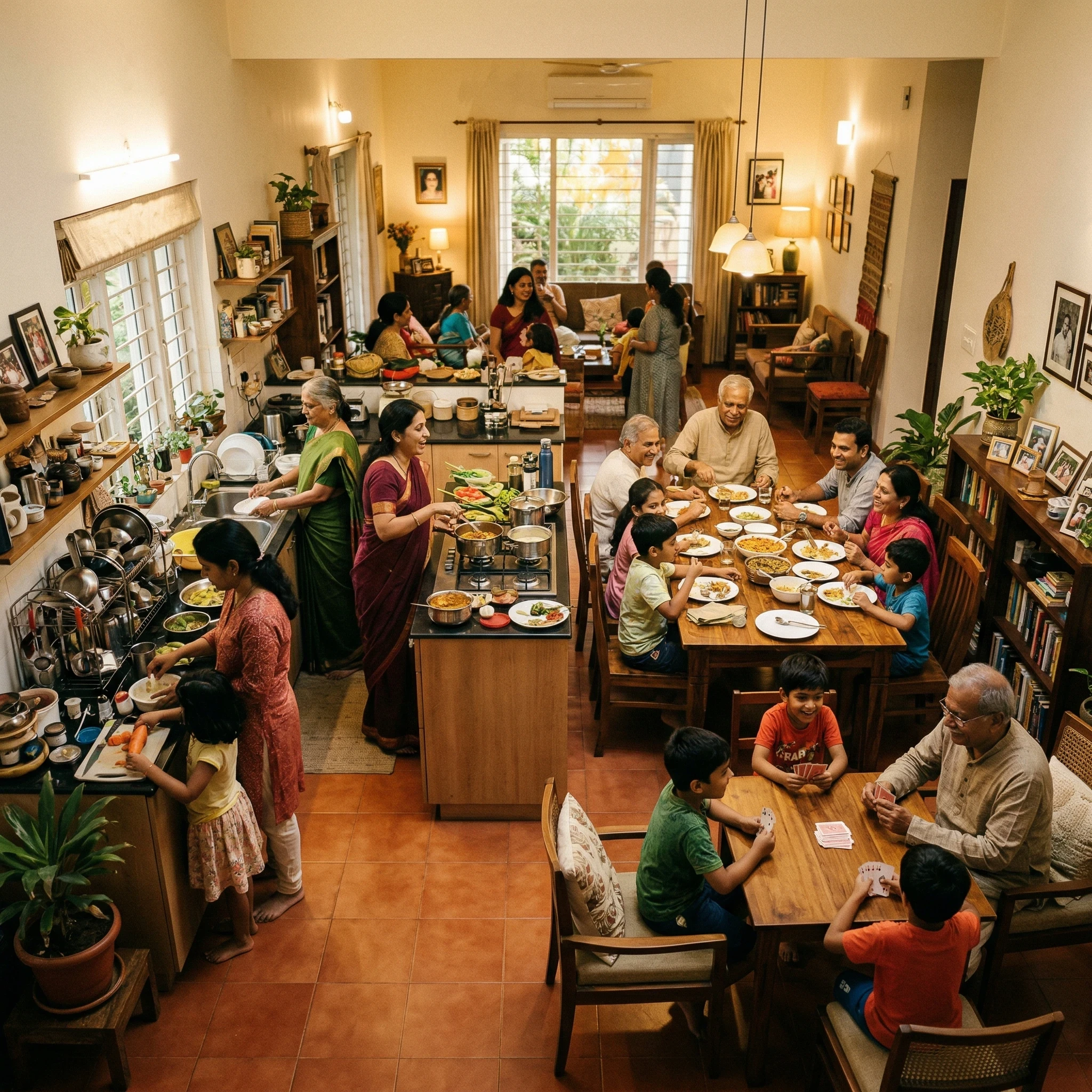
“Trust is the table — the surface on which every South Asian family gathering either comes alive or quietly falls flat. Build it well, and everything else follows.”
What Trust Really Means in Desi Family Dynamics
In a general sense, trust is simple: the belief that someone has your best interests at heart, will keep their word, and will not use what you share against you. But desi family dynamics add layers to this that are worth naming honestly.
There is the trust between parents and adult children, complicated by years of decisions made “for your own good” that were never explained, and by the adult child’s growing need to be seen as a capable person with a valid perspective.
There is the trust between siblings, often strained by perceived favoritism, by who carried more of the family burden, by things said (or unsaid) at a critical moment years ago that were never properly addressed.
There is trust between in-laws, where two families with completely different cultures, communication styles, and expectations are suddenly sharing the most intimate parts of life. And there is the trust between generations, the unspoken question of whether the older generation’s sacrifices are truly seen and honoured by the younger one, and whether the younger generation’s choices are genuinely respected in return.
Each of these is its own intergenerational relationship with its own history. And each can be rebuilt, with patience, honesty, and a willingness to try.
Why Building Connection Is Complicated in Our Families
South Asian families communicate differently. We express love through action rather than words – through cooking, through showing up, through sacrifice — rather than through direct emotional expression. This is beautiful. It is also sometimes a genuine barrier to the deeper connection we are all actually looking for.
When love is rarely spoken, and approval is hard-won, family members can spend years unsure of where they truly stand with each other. When difficult topics are avoided to preserve harmony, small hurts accumulate into walls. When family honor becomes more important than honest conversation, people learn to perform rather than connect.
A GENTLE REFRAME
Indirect communication is not dishonesty. Prioritizing family harmony is not avoidance. These are cultural values with real wisdom. The invitation is not to abandon them but to notice when they are quietly getting in the way of the connection they were meant to protect.
None of this is anyone’s fault. It is the water we swim in as diaspora families. But understanding it is the first step to something better, family gatherings where people feel genuinely close, not just obligated to be there.
The Modern Mindset Shift That Changes Everything
Here is the shift that makes the biggest difference in desi family communication, and it is available to every generation: moving from performance to presence.
Performance is showing up to a family gathering already armored, ready with the right answers about your career, your children’s grades, and your marriage. Saying what keeps the peace. Leaving exhausted.
Presence is showing up as yourself, imperfect, sometimes uncertain, but genuinely there. It requires trust to do this. And it also builds trust, because when one person allows themselves to be real, it permits others to do the same.
The modern mindset for South Asian family relationships is not about abandoning desi values. It is about adding to them, bringing the emotional honesty and boundary awareness of a generation raised between two worlds, and weaving it into the warmth and loyalty that have always been our family’s greatest strength.
“The goal is not a desi family gathering without conflict. The goal is a gathering where conflict does not break the connection, because the trust underneath is strong enough to hold.”
Building Connection Day to Day: What It Actually Looks Like
CONSISTENCY OVER GRAND GESTURES
Trust in Indian family relationships is not built in a single moment of honesty or one heartfelt conversation, as much as we might wish it were. It is built through the accumulation of small, reliable actions over time. Calling when you said you would. Remembering what matters to someone and asking about it. Following through on the unglamorous commitments, not just the celebrations.
In South Asian family terms, this might look like: the sibling who always shows up to help with the move, not just the housewarming. The parent who asks about your life without immediately redirecting to advice. The adult child who calls their parents on a Tuesday, for no particular reason. These unremarkable moments are the actual foundation of a deeper family connection.
DESI FAMILY COMMUNICATION IS HONEST AND KIND
There is a version of honesty that uses truth as a weapon. That is not what we are talking about here. Honest desi family communication means saying the real thing, but with care for how it lands. It means not pretending everything is fine when it is not. It means being willing to name a tension instead of letting it quietly fester for another decade.
For many families, this is a new muscle. We were often taught that keeping the peace was more important than speaking the truth. Learning to do both simultaneously, to be honest and kind at the same time, is one of the most valuable skills a diaspora family can develop together.
BOUNDARIES AS A FORM OF RESPECT IN INDIAN FAMILY RELATIONSHIPS
In Western discourse, boundaries are often framed as walls that protect the individual. In South Asian family dynamics, it helps to reframe them differently: boundaries are the conditions under which you can show up fully and sustainably. They are not rejection, they are the reason you can keep coming back.
A family member who names their limits is giving others accurate information to work with. That is an act of trust in the intergenerational relationship, not a withdrawal from it.
REPAIRING BROKEN TRUST IN FAMILIES
In South Asian families, apology can be complicated. A direct “I am sorry” is sometimes culturally unfamiliar; love is more often demonstrated by showing up differently, by cooking something, by quietly making things right without naming what went wrong. Both approaches have value. But sometimes the explicit acknowledgment matters enormously to the person who was hurt.
IF YOU ARE THE ONE REPAIRING
You do not need a grand gesture. You need consistency. A sincere acknowledgment of what happened, a genuine change in behavior going forward, and patience, because trust rebuilt after a rupture takes time to feel solid again. Show up. Keep showing up. That is the repair.
Building Connection At Family Gatherings
South Asian family gatherings are where trust becomes most visible, and most fragile. They are the moments where old desi family dynamics resurface, where comparisons are made, where someone says the thing they have been holding for months. They can be the most nourishing occasions in a family’s life, or the most draining. Often both, in the same afternoon.
Here is what makes the difference at every gathering:
- Who holds the emotional space? Every family gathering needs at least one person actively managing the emotional temperature of the room, redirecting a conversation heading somewhere painful, making sure quieter family members feel included, noticing when someone has withdrawn, and gently checking in. This is not the host’s job exclusively. It is everyone’s shared responsibility.
- What is addressed and what is left for a smaller setting? Not every family gathering needs to resolve every outstanding tension in desi family dynamics. Some things are better addressed one-to-one, quietly, away from the group. Knowing what to bring up and what to let rest is wisdom, not avoidance.
- How intergenerational relationships are honored at the table. Gatherings where the elders are performing their role and the young people are performing theirs, but nobody is actually connecting across generational lines, are exhausting for everyone. Find the shared moments: the card game everyone plays, the family story that gets told every time, the cooking that happens together rather than being watched from the sofa. These rituals are where real connection lives.
- Whether people feel seen, not just fed. The most memorable family gatherings are the ones where someone made you feel that your specific presence mattered. A question asked with genuine curiosity. An elder who remembered something you mentioned last time. A cousin who checked in without an agenda. This is trust made tangible, and it is what keeps people coming back to gather again.
When the Connection Has Been Broken in Desi Family Relationships
Sometimes, trust in family relationships is not just a little frayed; it is genuinely broken. By a betrayal of confidence shared at a gathering. By something said that cut deeper than the speaker perhaps intended. By years of feeling unseen or unfairly treated in the intergenerational dynamic. By a decision that affected everyone but consulted no one.
These ruptures are real, and they deserve to be taken seriously, not minimized with “that’s just how our family is” or papered over with a big festive occasion that pretends nothing happened.
The path back is rarely quick and never linear. But it is almost always possible if both sides are willing to take even one small step toward each other.
- Name it privately first. Before a gathering, before a group conversation, name what happened to the person it involves, one-to-one. This takes courage. It is also the only real way through.
- Do not require a perfect apology before you can move. In South Asian family dynamics, the explicit apology may not come in the form you expected. Watch for the gesture. The extra effort. The changed behavior. Sometimes that is the apology.
- Give it time and keep showing up. Rebuilt trust in Indian family relationships is built exactly like new trust, through small, consistent, reliable actions over time. There is no shortcut, but there is always a path.
- Know when to seek outside support. Culturally competent family counsellors who understand South Asian family dynamics and diaspora family life exist in most major cities. Using them is not an admission of failure — it is an investment in the family’s future together.
Frequently Asked Questions
Why do South Asian family gatherings so often feel tense?
Tension at desi family gatherings is almost always a symptom of something unaddressed in the relationships underneath. The gathering itself is rarely the place to resolve it, but it can be a place to practise. Practise being genuinely curious about someone rather than evaluating them. Practice letting a comment pass rather than responding defensively. Small acts of trust, repeated across many gatherings, gradually shift the whole atmosphere over time.
How do I bring up a trust issue in my desi family without it turning into a bigger conflict?
Choose a quiet moment, not during a gathering, not when emotions are already running high. A private, one-to-one conversation with the specific person involved is almost always more productive than a group discussion. Lead with how you felt rather than what they did. “I felt hurt when…” lands very differently from “you always…”. Give them room to respond without interrupting. The goal is understanding, not winning.
My parents show love through doing, not saying. How do I build a deeper connection?
Meet them in their language first. Acknowledge the doing, the early morning chai, the food sent home, the WhatsApp forward that means they were thinking of you. Trust across a communication style gap is built by showing you see and value how the other person expresses themselves, even as you gently introduce your own way. Over time, both sides often naturally expand their repertoire.
How do we rebuild connection in our South Asian family after a serious falling out?
Slowly, and with realistic expectations. One conversation will not fix it. What matters is the direction of travel; are both sides willing to take even one small step? Start there. Acknowledge what happened without demanding a particular response. Then keep showing up, consistently, over time. Trust rebuilt after a rupture in a desi family relationship can actually be stronger than what was there before, because it was chosen, not assumed.
How do I make our family gatherings genuinely joyful rather than just dutiful?
The shift from dutiful to joyful gatherings happens when at least one person in the family decides to show up differently, with genuine curiosity rather than performance, with warmth that is not conditional on agreement. That energy is contagious. Start small: make one person feel truly seen at the next gathering. Notice what happens to the room when you do.
Bringing It Home
Building a deeper connection in family gatherings is not a destination your family arrives at and then maintains effortlessly. It is a practice, something chosen, again and again, in small moments that accumulate into something lasting.
In desi families, this practice is both harder and more richly rewarding than in many contexts, because the love that underlies it is so deep, and the gatherings that become possible when trust is strong are some of the most meaningful experiences life offers.
The table is set. The chai is brewing. The question is whether the people who gather around it feel truly safe to be themselves there — seen, valued, and genuinely connected.
That is worth working for. Worth the uncomfortable conversation, the patient repair, and the consistent small effort. For both generations. For the whole family. For diaspora families, building something new while honoring everything that came before.
“Trust is the table. Connection is what happens when everyone finally sits down — not to perform, but to belong. That is the gift every family gathering, at its very best, has always been.”