
Jump to: Why It Works · Setup & Decor · Food Stalls · Games · Desi Corner · Age Guides · DIY Budget · The One Moment · Quick Start
My daughter came home from a birthday party and said something that stopped me mid-sentence.
“Mum, why don’t our parties have the games?”
She was seven. She had just been to a classmate’s birthday — bounce house, face paint, a DJ, the whole production. Beautiful. She had a great time. But something was missing for her and she could not name it yet.
I knew what it was.
The games she was thinking of were the ones she had seen in photos and videos from back home. Kanche in the dirt. Pittu garam in the gully. A carrom board on a charpoy with three generations arguing about whose turn it was. The kind of games where you did not need anything expensive — just space, a few friends, and someone’s dadi threatening to retire from the game if she did not win the next round.
She had never played those games. She had only ever heard about them.
That was the year I threw the first backyard carnival.
Not a Western carnival with striped tents and cotton candy machines. A desi one. The kind where every game station has a story behind it and every child goes home knowing something about where their family came from.
That party is what this guide is built on. The games that connect our kids to their roots. The food stalls that smell like back home. The collective warmth of a crowd that spans three generations and two continents — all in one backyard, in the summer sun, making noise together.
This is the backyard carnival your kids will talk about when they are adults planning parties for their own children.
If you are desi abroad — or raising kids abroad
The Desi Diaspora Corner in this guide is the whole point. The Indian childhood games section — pittu garam, kanche, lattoo, stapoo, Antakshari — is the part that makes this carnival different from every other backyard party your kids have ever been to. And the part that makes their desi identity feel real, not just talked about.
What is inside:
- Why a backyard carnival is the perfect format for desi families abroad
- Setup and decorations — how to create the carnival atmosphere
- Food stall guide — the desi street food stations that define this theme
- Games — Western carnival games and the desi games that steal the show
- ? Desi Diaspora Corner — Indian childhood games with full setup guides
- Age guides — for little kids, big kids, teens, and the adults who refuse to sit down
- DIY budget guide — how to do this for under $150
- The one moment — what this party is really for
- Not sure where to start? Quick decision guide
The one party format that works for every generation, every background, and both worlds at once.
Why a Backyard Carnival Works for Desi Families Abroad
Most party themes require a specific audience. A Bollywood Retro Night works best with 1st gen adults who grew up with those songs. A Kids Glow Party works best when you do not mind UV paint on your walls.
A backyard carnival works for everyone. Always.
Grandparents sitting in chairs watching the kids run. Teens too cool to admit they are having fun but absolutely not leaving. Six-year-olds who have been running since 11am and show no signs of stopping. Non-desi neighbours who walked over and stayed for three hours.
But here is what makes the desi backyard carnival specifically powerful for families raising kids abroad:
❌ What kids abroad usually get
- Western party games they have already played at school events
- Food they eat every week
- No connection to where their family came from
- Fun — but forgettable by Monday
✅ What this carnival gives them
- Games their dadi and nani played as children
- Street food that smells and tastes like back home
- Stories attached to every game station
- An identity they can feel, not just hear about
When a seven-year-old in Dallas learns to play kanche for the first time and their grandmother says “I played this in the gully every day after school” — that is not just a game. That is a thread connecting two childhoods across fifty years and ten thousand miles.
Your backyard does not need to become a fairground. It needs to feel like a gali.
Setup and Decorations — Creating the Carnival Atmosphere
Forget the red and white striped tents. That is a Western carnival. This is a desi one.
The atmosphere you are building is the feeling of an outdoor gathering back home — colourful, warm, slightly chaotic in the best possible way, and smelling like something delicious is cooking nearby.
Five things that create the atmosphere
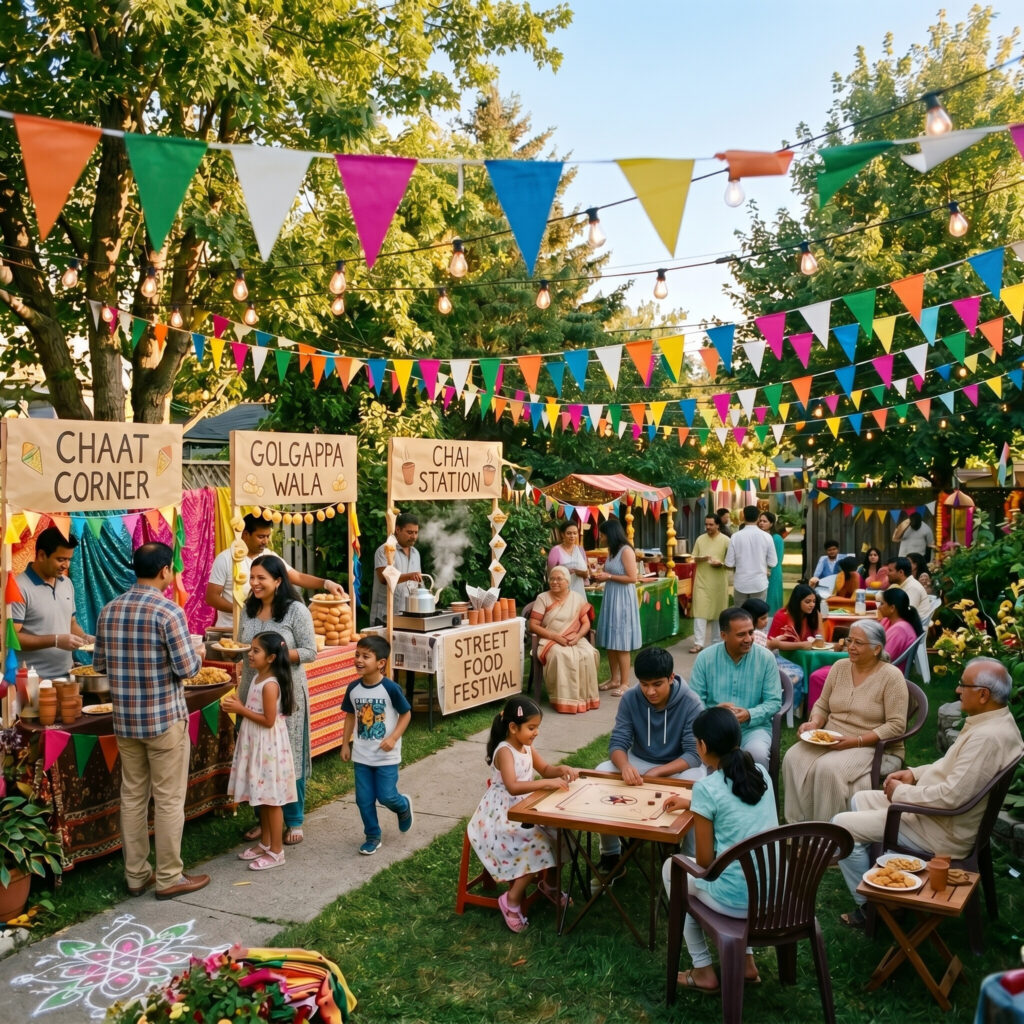
1. String lights and colourful bunting flags
- Warm white string lights overhead between trees or poles — not cool white, not neon. Warm. Makes everything golden.
- String small triangle bunting flags between the stall edges, along the entrance, and overhead between the lights. Mix saffron, green, white, and magenta — the colours read as festive and desi without needing any explanation.
- Layer the flags at two heights if you can: one line of lights overhead, one line of flags at eye level along the stalls. The depth makes the whole space feel like a proper carnival gali.
- Test the lighting at dusk before the party — this is when the carnival looks most magical.
2. Food stall signs on kraft paper
- Hand-write each stall name on brown kraft paper and pin above each station. “Chaat Corner.” “Golgappa Wala.” “Chai Station.”
- The handwritten signs create the gali aesthetic instantly. Printed signs feel corporate. Handwritten signs feel home.
- Write dish names in both English and Hindi/Urdu for kids who are learning.
3. Colourful dupattas as table runners
- Mix saffron, emerald, and magenta dupattas as table runners across game and food stations.
- Cheap, immediately desi, and completely unlike any other carnival your guests have attended.
- Let kids pick their favourite colour to wear as a sash for the day. Instant costume, zero effort.
4. A chalk rangoli at the entrance
- Draw a simple geometric rangoli design at the entrance with chalk before guests arrive.
- Set up a chalk rangoli station where kids can add to it throughout the afternoon.
- For non-desi guests: one small card explaining what rangoli is. One paragraph. Takes 30 seconds to read.
5. A photo backdrop station
- One colourful dupatta or fabric panel hung against a fence or wall.
- A printed sign: “Step right up!” in chalk-board style.
- A shared photo album QR code next to it. Guests add their photos directly. No WhatsApp forwarding chaos.
The food is the party. Each stall is a memory.
The Desi Street Food Stalls
This is what separates a desi backyard carnival from every other backyard party. The food does not come from a catering tray. It comes from stalls — individual stations, each with a name, each with a story.
Set up each stall on a folding table with a kraft paper sign above it. Use newspaper cones for serving. Stack the kulhads. Put the chutneys in small bowls. Make it look exactly like what it is: the gali back home, recreated in your backyard.
🥙 Chaat Corner
Alu chaat and bhel puri in newspaper cones. Three chutneys — mint, tamarind, imli. Label spice levels clearly. This stall will have the longest queue all afternoon.
💧Golgappa Station
Puris with tamarind and mint water, served one at a time. Assign one person as the “golgappa wala.” The drama of eating it in one shot is the whole point. Non-desi guests will attempt it. Everyone will laugh.
🫘 Samosa Stall
Samosas with three chutneys. Make the night before or source from your local Indian restaurant. Serve warm. Stack them in a pyramid. Someone’s baba will eat seven and claim he only had two.
☕ Chai Wala
Big pot of masala chai on a portable stove, served in clay kulhads. This stall stays open the entire time. The smell of chai is the single most powerful atmospheric element of the whole carnival.
🍜 Maggi Counter
A big pot of Maggi noodles. Yes, really. Serve in small paper cups. Every child will eat three servings. Every adult will eat two and pretend they only had one taste. Most nostalgic dish on the menu.
🍬 Mithai & Snacks
Hajmola, Aam Papad, glucose biscuits, small mithai pieces. Served in a bowl at a low table kids can reach themselves. This stall requires no supervision and will be empty within 45 minutes.
🍽️ How to run the stalls
No cutlery. No plates. Everything eaten standing up, from newspaper cones or kulhads, exactly as it should be.
Assign one person per stall as the “stall wala” — give them a sign to wear. Adults love this role. It gives them something to do and adds to the atmosphere.
Keep food in a well-lit area, not in direct sun. Replenish each stall throughout the afternoon rather than putting everything out at once.
The games are the memory. Every stall tells a story.
Carnival Games — Western Classics and Desi Originals
Run five to six game stations around the backyard. Mix Western carnival games that kids already know with desi games they are learning for the first time. The mix is intentional — familiar entry points lead into new experiences.
Western carnival games (the familiar anchor)
| Game | Ages | How It Works |
| Ring toss | All ages | Bottles in a row, bracelet rings as the toss. Award small prizes — mithai, Aam Papad, stickers. Every kid already knows this one. |
| Can knock-down | All ages | Stack empty tin cans in a pyramid. Guests throw a ball to knock them down. Adults get competitive fast. |
| Face paint station | Kids | Assign an older child or adult as painter. Simple designs — flags, flowers, stars. Keeps a rotating queue busy all afternoon. |
The desi games — full setup guides in the Desi Diaspora Corner below
| Game | Ages | Why It Matters |
| Carrom board tournament | All ages | The highest-engagement station of the entire carnival. Grandparents will be playing within 10 minutes of arrival. |
| Pittu Garam | Kids + teens | Seven stones, one ball, two teams. Chaotic, brilliant, genuinely the loudest game of the afternoon. |
| Kanche (marbles) | Kids | Flick your shooter to knock opponents’ marbles out of the ring. Draws a crowd of grandparents telling stories. |
| Lattoo (spinning top) | Kids + adults | Whose top spins longest? The most cross-generational game at the carnival. |
| Stapoo (hopscotch) | Kids | Grid on the ground, stone on a number, hop through. Needs only chalk. |
| Gully cricket | All ages | Runs in the background all afternoon. Absorbs every age group between other activities. |
| Antakshari | All ages | At the chai station in the afternoon. Runs on nostalgia and chai. Zero equipment cost. |
Which games to set up for your crowd
Small backyard (under 30 guests)? Carrom board + kanche + ring toss + face paint. Four stations, manageable in a small space.
Large outdoor space (30+ guests)? Add pittu garam, gully cricket, and lattoo. The more space, the more wonderful.
Multi-generational crowd? Carrom is your anchor. Every generation plays. Every generation argues about the rules. This is correct.
🧧 Desi Diaspora Corner
Every backyard carnival guide covers ring toss and face paint. This is the part none of them cover.
These are the games your parents played in the gully. The games their parents played before them. The games that exist in every desi childhood story but have never been played by your children — because nobody has set them up yet.
Today, you set them up.
The Indian Childhood Games — Full Setup Guides
⚡ Pittu Garam (Seven Stones)
The story: Played in every gully, colony, and school yard across the subcontinent. Two teams, one tower of seven flat stones, one ball. The throwing team knocks down the tower and races to rebuild it. The fielding team tries to hit them with the ball before they finish.
Setup: Find 7 flat stones or use 7 plastic plates stacked in a tower. Mark a throw line with chalk. Use a soft foam ball. Explain the rules once — kids figure out the rest in 60 seconds.
For kids abroad: Before you start, tell them: “This is the game your nana/dadi played after school every day.” Then watch them play it with everything they have.
Ages 6+ · 6–12 players · open space needed
🔮 Kanche (Marbles)
The story: One of the oldest games in the subcontinent — versions of kanche have been played since the Harappan age. Children collected their marbles like currency. Losing your favourite kancha to a better player was genuinely devastating.
Setup: Chalk a circle about 1 metre wide on the ground. Each player puts 3–5 marbles inside the ring. Players take turns flicking a shooter marble from the edge to knock opponents’ marbles out. Marbles that land outside the ring are yours to keep.
For kids abroad: Have an elder play the first round with the children. The moment a grandmother crouches down, lines up her shooter marble, and flicks it with practised precision — that is the moment that makes the whole carnival worth planning.
Ages 5+ · 2–6 players · paved surface ideal
🪀 Lattoo (Spinning Top)
The story: Spinning tops have been played in the subcontinent since 3500 BC. The lattoo requires skill — wrapping the string correctly, the exact wrist motion on the throw. A child who could spin their lattoo the longest was genuinely respected.
Setup: Buy wooden spinning tops with string. Demo the wrap and throw once for the children. Then step back — they will spend 30 minutes mastering it. Run a competition: whose top spins longest?
For kids abroad: When a grandfather picks up the top and throws it with the muscle memory of fifty years — watch the children’s faces. That reaction is the whole point.
Ages 5+ · 2–8 players · hard flat surface needed
⬛ Stapoo / Hopscotch
The story: Called Stapoo in the north, Nondi in Tamil Nadu, Kunte Bille in Karnataka. Every version involves the same grid, the same hopping, the same quiet concentration of trying to balance on one foot while everyone watches.
Setup: Draw the classic grid with chalk. Number boxes 1–10. Each player throws a stone onto a numbered box and hops through the grid on one foot, skipping that box. Simple rules, enormous entertainment, zero equipment cost.
Ages 4+ · 2–8 players · chalk on pavement
🎵 Antakshari — Carnival Edition
The story: The original desi party game. No equipment. No setup. Just people, songs, and the rule that your song must begin with the last letter of the previous song.
Setup for the carnival: Run it at the chai station in the late afternoon. Split into two teams — kids on one side, adults on the other. The team that cannot think of a song in 10 seconds loses a point. Award the winning team first pick of the mithai box.
Why it matters: This is the game where children hear their parents and grandparents sing without any self-consciousness. Where a 9-year-old surprises everyone by knowing an old Mohammed Rafi song because they heard it in the car for years. Yaar, yeh moment sab kuch hai.
The Letter to Your Inner Child Station
Set up a small table with paper, pens, and a prompt card: “Write one thing you loved about being a child — and one thing you want your child to feel today.”
Adults write. Children draw. Collect the notes in a jar and read them aloud at the end of the afternoon. This takes 10 minutes to set up and costs nothing. It is the moment adults cry at the backyard carnival, and that is exactly the right response.
The Desi Glossary Card — print one per table
| Word | What it means |
| Pittu Garam | Seven stones game. Two teams, one tower, one ball. Played in every gully across the subcontinent. |
| Kanche | Marbles. Flick your shooter to knock opponents’ marbles out of the ring. The marbles you win are yours. |
| Lattoo | Spinning top. Wrap the string, throw with your wrist, watch it spin. Longest spin wins. |
| Stapoo | Hopscotch. Grid on the ground, stone on a number, hop through without touching the lines. |
| Antakshari | Song chain game. Your song must start with the last letter of the previous song. All ages play. |
| Gully | The lane between houses where children played every afternoon after school. |
Making Non-Desi Guests Feel Included
A backyard carnival is the most naturally inclusive desi party format. Games are universal. Street food communicates through smell and taste before anyone explains anything.
- Pair them with a child for the first desi game. Children are patient teachers. A non-desi adult learns kanche from a 7-year-old and leaves the stall genuinely happy.
- Give them the golgappa experience personally. Show them how to eat it in one shot. The moment of attempting it — and either succeeding or laughing — is the most memorable individual moment of the carnival for non-desi guests.
- Include them in Antakshari with Western songs. One Western song per round allowed. Keeps non-desi guests in the game and often produces the funniest moment of the afternoon.
Every generation plays differently. Every generation plays together.
The Backyard Carnival by Age Group
The beauty of this format is that every generation has a role. Nobody sits out. Nobody watches from the side.
🎂 Little Kids (Ages 4–8)
High energy, short attention span, needs rotation every 20 minutes.
| Their games | Face paint station, ring toss, stapoo hopscotch, kanche marbles with a patient adult alongside. Keep a rotation — 20 minutes per station maximum before they need to move. |
| Their food | Samosas, small chaat cups, Maggi, Hajmola and Aam Papad from the mithai stall. Juice boxes or nimbu paani. Keep golgappa for ages 6+. |
| The magic moment | A grandparent sits down and plays kanche with them. The child does not yet understand what they are witnessing. They will understand it in 20 years. |
| Supervision | Assign one adult per 5 small children for game rotation. Build a shaded rest area with snacks and water. Check on small children every 30 minutes. |
🎪 Big Kids & Teens (Ages 9–17)
Competitive, social, want to feel capable not managed.
| Their games | Pittu garam as a proper team tournament. Carrom bracket. Gully cricket on the lawn. Lattoo competition with scored rounds. This age group will self-organise once games are set up. |
| Their role | Assign older children as game station helpers — they explain rules to younger kids and manage queues. This gives them responsibility and status. They will take it seriously. |
| The magic moment | A teen beats an adult at carrom and the adult demands a rematch. The teen wins again. By round three, they are talking properly for the first time all afternoon. |
| Food | Everything. Multiple rounds. The golgappa station specifically — teens approach it like a challenge and always come back for more. |
👑 Adults & Elders
They came to sit. They will not sit. This is correct.
| Their games | Carrom is the adult anchor. Set up two boards and a tournament bracket. Antakshari at the chai station. Elders who “just want to watch” will be playing carrom within 15 minutes. This happens every time. |
| Their role | The storytellers. Before each desi game begins, ask an elder to explain how it was played in their childhood. 3 minutes per game. Record these stories if you can. |
| Food | The chai station is their territory. Do not fight it. Set up comfortable seating nearby. The best conversations of the afternoon will happen within five metres of the chai wala. |
| The magic moment | An elder teaches a grandchild to play kanche, lattoo, or pittu garam. A game that was ordinary childhood is now transmission of heritage. Watch the elder’s face when the child asks to play again. |
You do not need a big budget. You need a big backyard and a big pot of chai.
DIY Backyard Carnival on a Budget — Jugaad Edition
For those of us running this from a suburb in North America or the UK — where the nearest Indian grocery is a 20-minute drive and the party store has never heard of a carrom board — here is the complete shopping list.
| Item | Cost | Note |
| Warm white string lights 48ft | $18 | The single most important atmospheric purchase. |
| Artificial marigold garlands x3 | $12 | Stall edges and entrance arch. |
| Colourful dupattas x4 | $16 | Table runners, sashes, photo backdrop. |
| Clay kulhad cups pack of 50 | $14 | Chai and chaat serving — non-negotiable. |
| Carrom board | $35 | Highest engagement item. Worth every dollar. |
| Marbles set + spinning tops | $12 | Kanche and lattoo — games that connect generations. |
| Outdoor chalk set | $5 | Stapoo grid, kanche ring, rangoli, game boundaries. |
| Food (chaat, samosas, Maggi, mithai) | $40 | Source most from Indian grocery. Maggi in bulk from Amazon. |
| Total | $152 | Full carnival for 25–35 guests. Ek dum dhamaka. |
Three things that cost nothing
- The stall signs. Kraft paper from any stationery store, thick marker, handwritten. Costs $3 for the paper. Looks completely authentic.
- The pittu garam stones. Find seven flat stones in any garden or park. Stack them. Done. The game that requires zero equipment budget.
- The Antakshari game. No equipment. No setup. Just people, songs, and chai. Highest-value activity of the afternoon at zero cost.
💡 The co-hosting formula
The backyard carnival works brilliantly as a co-hosted event. Three families, each taking one category: one handles food stalls, one handles games setup, one handles decor and logistics.
Split costs three ways and the per-family spend drops to $50–60. Total party for 40+ people. Sabke liye kuch hai — something for everyone.
🌿 The One Moment
The moment a grandparent teaches a grandchild a game they have not played since childhood. That is the carnival. Everything else is just the setup.
It will happen on its own if you create the conditions. But you can also create it deliberately.
Before the kanche game begins, ask the oldest person at the carnival to play the first round with the youngest child. No cameras yet. No crowd. Just the two of them, crouched over the chalk circle, the elder lining up their shooter marble with the muscle memory of sixty years.
Then the elder flicks the marble. It rolls perfectly, knocks three others out of the ring. The child’s mouth opens.
“Dadi, how did you do that?”
“I played this every day when I was your age.”
“Can you teach me?”
That conversation. That is worth every stall, every pot of chai, every hour of planning.
Have someone standing by with a phone at this moment. Not to interrupt it — to record it quietly from a distance. That video will be watched by that child when they are an adult.
Yeh sirf party nahi hai. Yeh virasat hai.
This is not just a party. This is heritage.
Find your situation. Find your starting point.
| Your Situation | Start Here |
| Small backyard (under 30 guests) | Carrom board + kanche + ring toss + face paint + chai station. Skip gully cricket and pittu garam until you have more room. |
| Large outdoor space (30+ guests) | All six game stations. Co-host with 2 families. Run a carrom tournament bracket on a whiteboard. Let it run itself. |
| Kids under 8 are the main guests | Face paint, stapoo, kanche with adult alongside, mithai stall. Two-hour format. Kids hit capacity fast. |
| Multi-generational crowd | Set up kanche and lattoo stations for elder-child pairing. Brief one elder to tell the story of each game before it starts. |
| Mixed desi + non-desi guests | Pair non-desi guests with a child for first desi game. Give them the golgappa experience personally. Include Western songs in Antakshari. |
| Tight budget under $80 | Borrow the carrom board. Collect pittu garam stones from the garden. Chalk for stapoo and kanche. Co-host for food costs. |
| First time running this format | Three stalls (chaat, chai, Maggi) and three games (carrom, ring toss, kanche). Enough for a first carnival. Build the full version next year. |
Make It Their Story — Not Just a Party
A backyard carnival is already a great afternoon. Any version of this is worth doing.
But the version that lasts — the one your children talk about when they are adults — is the one built around your specific family.
Their games. The ones your parents played. The one your grandmother still remembers the rules to, even now.
That is the carnival worth planning. Not because it looks perfect. Because it feels like yours.
If you want help building that version — a fully personalised backyard carnival theme designed around your family’s specific games, food, stories, and crowd — reach out at connect-n-rejuvenate.com.
No templates. No borrowed aesthetics. Just your gali, recreated in your backyard, for the children who have never seen it — and the elders who have never forgotten it.
▶ connect-n-rejuvenate.com/contact
Let’s plan a carnival your children will tell their children about.
Part of the Complete Guide to Desi Party Themes · Also see: Glow in the Dark Party Guide · Top 10 Unique Desi Party Themes
Leave a Reply