
The Diwali I grew up watching wasn’t planned. It just happened, because everyone lived within a few streets of each other and the whole neighborhood was already primed to celebrate the same week. The Diwali I run now gets a calendar invite, a grocery list, and a group text about who’s bringing what. For years I treated that difference like a loss. It isn’t. It’s just a different set of tools for the same result.
There’s a quiet assumption a lot of us carry into hosting abroad: that the “real” version of Diwali happened back home, and whatever we build here is a compressed, lesser copy of it. That assumption doesn’t hold up. Diwali has never had one fixed format, it already looks different from state to state within India, Gujarati households mark it differently than Punjabi ones, South Indian timing differs from North Indian timing. What travels isn’t a specific set of steps. It’s the underlying instruction: clean the space, invite light in, gather people, share food. Everything else is implementation detail, and implementation detail is allowed to change with your circumstances.
The families who describe their diaspora Diwali as “better than back home” usually aren’t exaggerating for effect. They’ve just built something that fits the people actually in the room, instead of running a fixed script designed for a different setting decades ago. Here’s how to actually build that, step by step.
A quick note before the list: this is written from a Hindu, puja-centered version of Diwali, since that’s the tradition I know. If your household observes this week as Bandi Chhor Divas or as Mahavira’s liberation, swap the puja references below for whatever your own observance looks like, the planning logic still holds either way.
1. Decide your actual date split before you plan anything else
Most working diaspora families quietly split this into two dates: the real puja, kept small and done close to the actual muhurat even on a weeknight, and the bigger gathering, moved to the closest weekend. That’s not a workaround to feel sheepish about, it’s the standard adaptation, and most temples and community organizations already operate this way for their own events. Pick both dates now and put them on the calendar before you plan anything else. Skipping this step is the single biggest reason hosts end up doing a rushed version of both.
2. Turn your guest list into a food plan, not just a headcount
Before you send invites, decide whether this is potluck or fully hosted. If potluck, assign categories, not specific dishes, one family covers a main, one covers a snack, one covers dessert, so you don’t end up with four boxes of mithai and no actual dinner. Send the assignment when you invite, not after.
3. Build a puja corner that works in the space you actually have
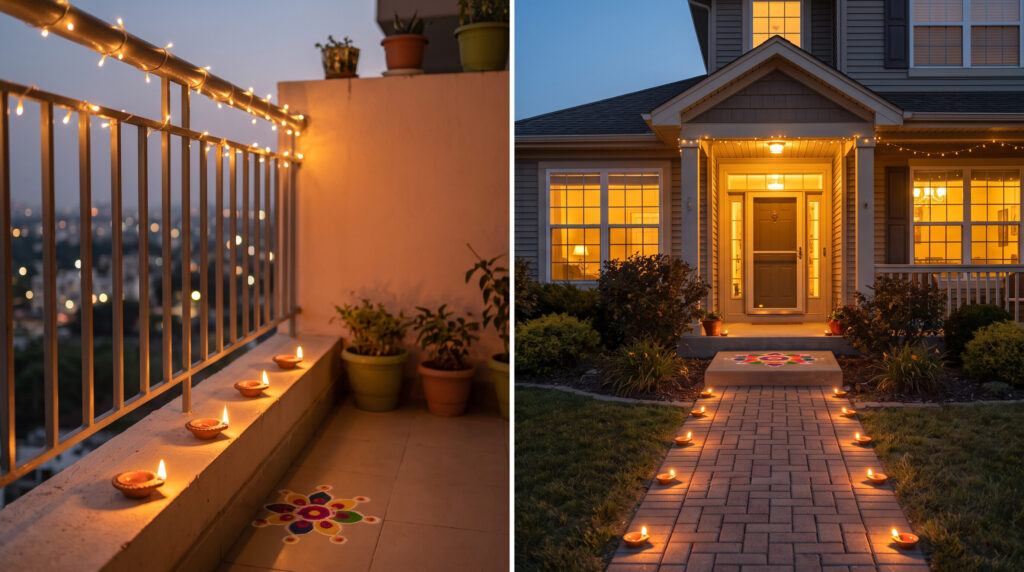
A puja doesn’t need square footage, it needs a clean, intentional spot. A cleared side table or counter section works as your altar, with a cloth or small runner, a photo or idol if your practice includes one, and a spot for diyas. Battery-operated diyas solve any open-flame building restriction without losing the visual of light in the space, and you can layer real diyas just outside your door or on a balcony where flame is allowed. Decide this spot a few days ahead, not the morning of, so it isn’t competing with dinner prep for the same counter.
4. Scale your rangoli to your actual entrance
A large floor design isn’t the point, a marked entrance is. A small stencil kit with colored rice or chalk at your apartment door does the same symbolic job as a large one at a house’s entrance, in about fifteen minutes. If you’re in a building with a shared hallway, ask first, some allow a small design that’s easy to sweep up, others don’t, and it’s a five-minute phone call rather than a surprise on the night.
5. Solve for noise and fire restrictions before someone asks
If fireworks aren’t allowed, sparklers usually are, check your specific city and building rules rather than assuming either way. If even sparklers are out, a tabletop diya arrangement with music playing still does real work toward making the night feel different from any other Tuesday, and it replaces the “mark the night as different” function fireworks were serving without losing it. Decide your substitute now so you’re not improvising one when a kid asks about fireworks at 6pm.
The corner-cutting that costs you something is skipping the puja altogether because the space feels wrong for it. The corner-cutting that costs you nothing is doing a five-minute version instead of a forty-minute one.
6. Give kids something to do besides sit through the puja
A short puja followed immediately by an activity keeps a six-year-old’s cooperation intact, and the puja itself should be short enough that a young kid’s attention span survives it. A rangoli station, a small diya-decorating table (paint, stick-on gems, plain pre-bought diyas), or a treasure hunt for wrapped sweets around the house all work. Set this up before guests arrive, not as an improvised response to a bored kid mid-evening.
7. Add one activity that gets the adults talking, not just eating
A round of antakshari works if your group knows old Hindi songs. A rangoli contest or a simple “guess the sweet” blind-tasting game works across generations and doesn’t require anyone to know specific rules. Pick one and announce it during dinner, don’t leave it to spontaneously happen, it usually won’t, and a strictly formal program does less for the night’s energy than an actual shared activity.
8. Write your day-of timeline the week before, not the morning of
Block it hour by hour: prep window, puja time, guest arrival, food, activity, wind-down. This is the single change that gets you out of the kitchen and into the room with your guests. A one-page timeline taped inside a cabinet door takes ten minutes to write and saves the whole night.
9. Prep one line explaining the night to anyone unfamiliar with it
If a guest’s partner, a neighbor, or a coworker’s family is coming and doesn’t know Diwali, have one sentence ready: “Tonight we light diyas and do a short puja to welcome prosperity into the house, then we eat far too much.” Say it near the start so no one spends the night confused about what’s happening around them.
10. Decide what you’re keeping for next year while it’s fresh
Right after, not weeks later, note what worked and what you’d change. Which dish ran out, which activity fell flat, what the timeline missed. This is the difference between rebuilding the plan from scratch every year and actually improving it.
Building this together
None of this requires getting the “authentic” version right. It requires deciding what this celebration needs to do for your specific household, this year, in this apartment or this backyard, and then building toward that. That’s the whole premise behind the Diwali Celebration Playbook I’m putting together, a real plan for exactly this kind of gathering, decor, food, timing, and all. More on that soon.
If you want the full story behind why each of these rituals exists in the first place, not just how to pull them off, I’ve written a companion piece on what each of Diwali’s five nights actually means, worth reading before or after this one. What follows here assumes you already know the basics and just want the plan for hosting it.
Leave a Reply