
I have never fully answered the question “where are you from” with one word.
Ahmedabad is where I was born. Dallas is where I built a life. Neither answer feels complete on its own, and for thirty years I’ve stopped expecting one to be.
Krishna never answered that question with one word either.
He was born a prince in a prison cell in Mathura. He was raised a cowherd’s son in Gokul. He built his own kingdom, on his own terms, in Dwarka. Three homes. Three identities. He never treated any of them as the fake one.
Janmashtami lets you skip that question entirely.
You were never required to pick.
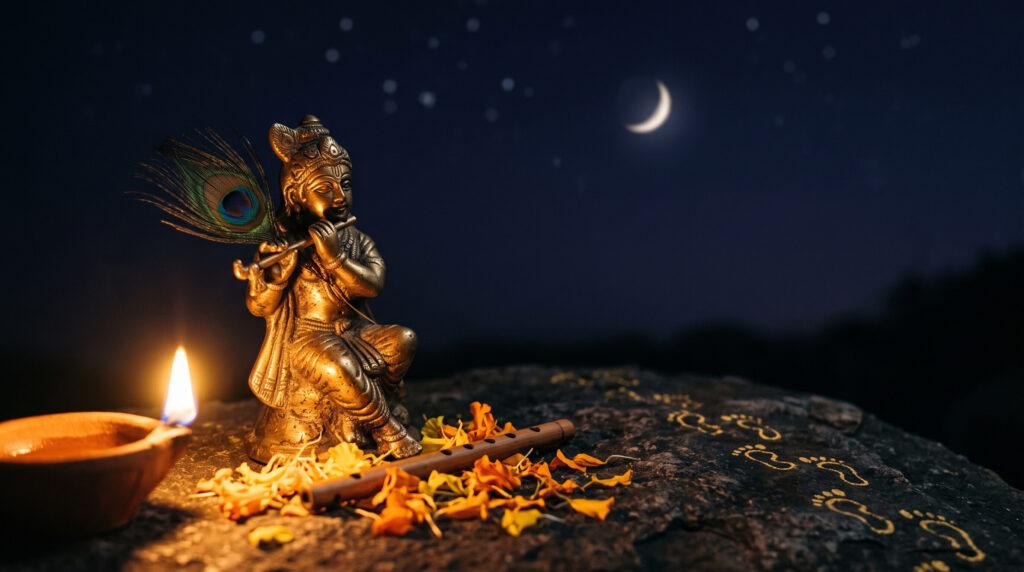
This festival marks the birth of Lord Krishna. For those of us building a life across two countries, his story maps onto something we live every day: belonging fully to more than one place at once.
In a culture that often asks immigrants and their children to resolve their identity into one clean answer, Krishna’s story offers a different model: You don’t have to choose a home. You get to carry all of them.
This post is for those of us raising families between two worlds, who want Janmashtami to reflect that rather than smooth it over.
Janmashtami at a Glance
- Festival: Janmashtami (Gokulashtami, Sree Jayanti, Ashtami Rohini)
- When: Friday, September 4, 2026 — eighth day of Bhadrapada, Krishna Paksha
- What it honors: Birth of Lord Krishna
- Core theme: Belonging to more than one home at once
- Emotional reminder: You were never meant to pick just one
The Three Homes of Krishna
Krishna’s life is usually told as one continuous story. It’s easier to understand as three separate homes, and what he carried from each one into the next.
Mathura: Where He Was Born
Krishna was born to Devaki and Vasudeva inside a prison cell in Mathura, under threat from his uncle Kansa, who had been warned this child would end his reign. His birthright was real. His birth home was not safe.
The night he was born, Vasudeva carried him across a flooding Yamuna river to a home that had nothing to do with royalty at all.
Gokul: Where He Was Raised
Yashoda and Nanda raised him as their own. Not because blood required it. Because love did. This is where the Krishna most people picture comes from: the butter thief, the flute player, the boy who charmed an entire village that had no idea he was born a prince.
Gokul gave him his personality. It was never going to be his permanent home, and it shaped him permanently anyway.
Dwarka: Where He Built His Own Life
As an adult, Krishna returned to Mathura, reclaimed his birthright, and then chose to leave it again. He founded Dwarka from nothing, on his own terms, as a kingdom that belonged fully to neither his birth family’s story nor his childhood one.
Dwarka was what Krishna built once he had carried Mathura and Gokul far enough to stand on his own, a life built by choice rather than circumstance.
Source: https://www.britannica.com/topic/Krishna
Why This Feels Like Home
If you moved abroad, or grew up as the child of people who did, you already know this shape.
Your Mathura is the place you or your parents were born: the birthright, the story that started before you had any say in it.
Your Gokul is what raised you. It shaped your accent, your humor, your instincts, even when it wasn’t where your name came from.
And somewhere ahead of you is a Dwarka: the life you’re building, not a copy of either place, chosen instead of inherited.
Krishna never apologized for any of the three. He didn’t perform more “Mathura” to prove his birthright, and he didn’t perform more “Gokul” to prove his childhood was real. He just carried all of it, visibly, into whatever room he was in.
The Part Nobody Names: Yashoda Wasn’t His Blood
The mother most associated with Krishna’s childhood, the one who chased him around Gokul with a rope and a wooden spoon, didn’t give birth to him.
For families abroad, this is the part of the story that rarely gets told alongside the butter-thief tales, and it’s the most useful one. The aunties who aren’t technically related. The friend’s parents who fed you like their own. The community that raised your kids a little, without anyone drawing up an agreement about it.
Krishna’s story treats that kind of family as just as real as blood.
The Pressure to Pick One Lane
We live in a place that often asks us to choose. A form wants one box checked. A new acquaintance wants a tidy answer to “where are you really from.” Kids raised between two cultures learn early to smooth themselves into whichever identity fits the room they’re standing in.
Krishna never did that. He didn’t perform less Mathura in Gokul, or less Gokul in Dwarka. He carried the accent, the habits, both mothers, into every room he entered, without editing himself down to fit it.
That refusal to pick one lane is rare. It’s also exactly what a lot of us are trying to model for our kids.
Bringing This Into Your Home
You don’t need to retell all three homes in one evening. Pick the thread that matches where your family is right now.
- If your kids are young: Tell the Gokul stories: the butter, the mischief, the flute. Let it be playful before it needs to be meaningful.
- If your kids are older: Tell them about Mathura and Dwarka too: that Krishna had a birthright he didn’t grow up with, and a life he built that wasn’t handed to him. Ask them what their own “Dwarka” might look like.
- If you’re hosting extended family: Ask an elder to share which of the three homes felt most like “home” to them growing up, and why. You’ll likely get three different answers in one room.
A Simple Janmashtami Rhythm
You don’t need a full day of ritual for this to land. Pick one moment from each home.
- Morning (Mathura): Say your family’s name and where it comes from out loud to your kids, even if the place feels unfamiliar to them now.
- Midday (Gokul): Cook or eat one dish that tastes like the home that raised you, not the one on your passport.
- Evening (Dwarka): Tell your kids about one choice you made to build the life you have now, one that nobody handed you.
- Night: Ask yourself one question: did I let all three homes show up today, or did I hide one to fit in?
Pause Here: Name Your Own Three Homes
Before continuing, take a moment.
Ask yourself:
- What’s my Mathura? The place my story started, whether or not I remember it.
- What’s my Gokul? The place that shaped who I am.
- What’s my Dwarka? The life I’m building that belongs to no one else’s story but mine.
You don’t have to rank them.
That’s the whole point.
The Real Heart of Janmashtami
Janmashtami doesn’t ask: Which home is the real one?
It asks: Can you carry all of them without shrinking any of them?
It reminds us that:
- Birthright and upbringing don’t have to compete
- Chosen family is not a lesser family
- The life you build doesn’t have to resolve where you came from. It can simply include it.
Honor this festival by naming all of your homes, out loud, at your own table.
And if you’re exploring festivals that reflect not just tradition, but the specific shape of a life lived between two worlds, the Cultural Celebrations series is here to walk with you, gently, thoughtfully, and without pressure.
Leave a Reply