
Every year, someone in the family lights the diya, sets up the kalash, and moves through nine nights of ritual. Somewhere along the way, most of us stopped asking why. You inherited the ritual. Now you’re the one trying to explain the meaning, to a kid who was born somewhere your parents never lived, without losing what actually made it matter in the first place.
Your own parents didn’t have to translate Navratri. They just had it. You’re likely the first generation in your family that has to hand this down on purpose instead of by osmosis. This isn’t a puja how-to. It’s the meaning underneath Navratri’s core rituals, explained the way you’d want it explained to you, so you have an actual answer the next time a kid, or you, asks why we do this.
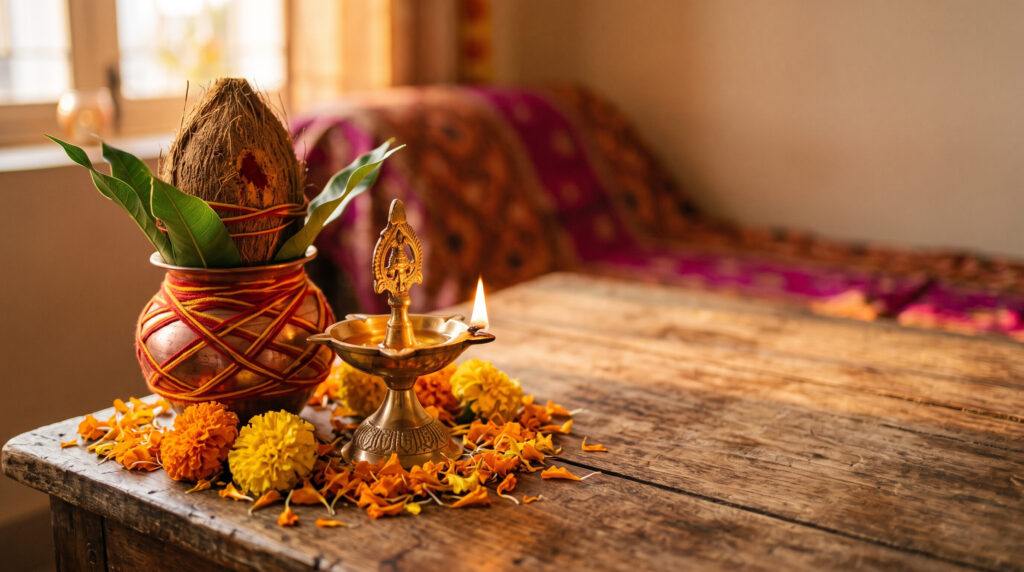
Ghatasthapana: connect with intention
On Day 1, a kalash gets installed, inviting the Goddess’s presence and formally opening the nine days. Strip away the specifics and here’s what’s actually happening: you’re setting something down as a marker of what you’re starting, not so different from writing down an intention before a new season of life.
Before you fill the kalash, take thirty seconds and name the one thing you want these nine days to mean for you. Health, patience, a relationship you’ve been meaning to repair. Write it down, even if no one else sees it. You’re not setting this down in isolation either: you’re starting it on Day 1 knowing you’ll come back to it every night for nine nights straight.
Try this: have every family member name one intention for the nine nights ahead, out loud at dinner.
💬 Explain it to your kids: “We’re starting something together. What’s one thing you want these nine days to be about?”
Want the actual pieces instead of improvising? Shop the kalash, diya, and family intention journal.
Garba and Dandiya: connect with community
Garba is danced in a circle around a lamp or a murti of the Goddess, often understood to represent life’s cycle moving around the one thing that doesn’t change at the center. Dandiya Raas is the version with sticks, standing in for Durga’s sword. Both are an act of gratitude for restoring balance.
Here’s the part that’s easy to miss if you only think of Garba as a party: it’s a nightly ritual. Nine nights of showing up to move in the same circle as your community is, functionally, a nine-night commitment to connection, the exact thing a lot of us abroad are quietly starving for. You don’t need a professional dandiya night with a DJ for that to count. A driveway, a speaker, and the people who’ll show up nine nights in a row does the same job.
Try this: before the music starts, have everyone in the circle share one person they’re grateful to have in it.
💬 Explain it to your kids: “We’re all moving around the same center together. What do you think that says about being part of a community?”
Worth knowing: Garba isn’t just associated with Gujarat, it originated there, and in December 2023, UNESCO inscribed “Garba of Gujarat” on its Intangible Cultural Heritage list, recognized in part for how the dance dissolves caste, class, and gender distinctions within the circle. That’s connection as recognized heritage, not just a nice way to describe a dance.
Want to bring that nine-night circle into your own home this year? The Navratri Ni Yaad Playbook is a done-for-you Gujarati Navratri gathering, shopping list, games, host scripts, and all, so you’re not building it from scratch alone. $37.
Kanya Puja: connect through values
On Ashtami and Navami, many families invite young girls into the home, wash their feet, and treat them, for that moment, the way you’d treat the Goddess herself, standing in for Durga, whose defining trait is strength.
That’s the version of divine femininity this ritual hands a girl before she’s old enough to ask for it in words: not “you are delicate and must be protected,” but “you contain the kind of power that gets called in when everything else has failed.” Having her feet washed and being served ahead of the adults in the room is a physical demonstration of that, not a lecture about it.
Try this: ask your daughter, niece, or a young girl in your circle, “what’s one quality that makes you feel strong?” Then actually listen to the answer.
Akhand Jyot and Golu, briefly
Two more rituals worth knowing, in smaller doses than the ones above, because they’re less about people connecting with each other and more about something quieter.
Akhand Jyot is a lamp kept burning continuously for all nine days, unbroken. The commitment isn’t really about the flame, it’s about showing up to tend something for nine straight days without missing one, the way trust with another person gets built by consistently showing up rather than one grand gesture. A good one to explain to kids as: “this light reminds us to keep showing up, even on the days it feels hard.”
Golu, mainly a Tamil, Telugu, and Kannada tradition, is a display of dolls and figurines built up on stepped platforms over the nine days. Navratri doesn’t look the same in every Indian home, and Golu is a good reminder of that: it doesn’t require a priest or a specific mantra, just a kid placing a doll on a step, which makes it one of the more literal ways this festival gets handed down across generations.
Dussehra: connect through letting go
The festival closes with Vijayadashami, marking good’s victory over evil. In much of North India, that’s the day an effigy of Ravana gets burned, its ten heads often read as ten vices, ego chief among them.
It’s easy to read the effigy-burning as pure spectacle, but the symbolism is closer to a release valve: nine days of intention-setting and community, closed out by one day of consciously letting go of whatever you’ve been carrying that isn’t serving you.
Try this: everyone at the table writes down one thing they’re ready to let go of, then folds the paper before anyone shares it out loud.
💬 Explain it to your kids: “If you could let go of one habit that isn’t serving you, what would it be?”
You don’t have to recreate Navratri exactly as you remember it
If you’re the parent trying to do all of this the way your parents did it, immaculate puja setup, nine full nights of dressing up, an extended community exactly like the one you grew up inside, that’s likely not because the ritual demands it. It’s because love and grief got tangled together somewhere along the way. You don’t have the same street full of relatives your mother had, and pretending otherwise every October is a fast way to make Navratri feel like one more item on the list instead of the thing that’s supposed to relieve it.
The tradition doesn’t require the scale. It requires the intention. One diya, lit and meant, does the job the elaborate version does. So does one family intention named out loud at dinner, one Garba song played in the living room with the furniture pushed back, one night of gathering the friends who are your community here even if there are six of them instead of sixty.
None of that is a lesser version of Navratri. It’s Navratri sized to the life you’re actually living, which is the only version that survives past this year.
If you read that and thought, actually, I do want the full version this year, just not built from scratch alone, that’s exactly what the Navratri Ni Yaad Playbook is for.
Quick reference
What is Ghatasthapana? The Day 1 ritual of installing a sacred kalash, a physical intention-setting practice for the nine days ahead.
Why is Garba danced in a circle? In many traditions, the circle represents life’s cycle, moving around the unchanging Goddess at the center. It originated in Gujarat and carries UNESCO heritage status as of 2023.
What is Kanya Puja? A ritual on Ashtami and Navami honoring young girls as embodiments of Durga’s strength.
What does Dussehra mark? The festival’s close, traditionally observed through the symbolic release of what no longer serves you.
Do I have to do every ritual for Navratri to count? No. The tradition asks for intention, not scale; a single ritual observed with meaning does more than nine performed out of obligation.
Fasting through these nine days too? Here’s the complete beginner’s guide to Navratri fasting: what to eat, what to avoid, and how to make it to Day 9 without running on empty.
Want to make your next celebration more intentional? Navratri doesn’t have to be elaborate to be meaningful. My free Intentional Celebration Blueprint helps you turn any celebration into a moment of connection, from choosing an intention to creating a simple experience your family will actually remember. Download it here & be part of community who get you.
Leave a Reply