
There is a particular kind of loneliness that comes with living between two worlds.
It is not the loneliness of being alone in a room. It is the loneliness of being in a room full of people and still feeling like something essential is missing. Like you are present but not quite home.
If you have spent any time living as a desi abroad — in the US, the UK, Canada, Australia, or anywhere far from where you grew up — you probably know this feeling. The friendships are real. The life you have built is real. But sometimes, especially at festivals, at milestones, at moments that would have been marked a certain way back home, there is a quiet ache. A sense that connection is thinner here than it used to be.
I moved to the United States at 15, from Ahmedabad, India. Thirty years later, I have built a life, raised children, and created a community I genuinely love. But I also remember exactly what it felt like in those early years — the specific hollowness of Diwali without the sounds, the smells, the chaos of a full house. The way a birthday felt smaller without three generations in the kitchen arguing about who made the better mithai.
What I learned over thirty years — slowly, imperfectly, and through a lot of trial and error — is that connection does not rebuild itself automatically. It has to be created. Intentionally. And for desi families living abroad, celebration is one of the most powerful tools we have for doing exactly that.
This is what Connect-n-Rejuvenate is built on. Not party planning. Connection — through the deliberate act of gathering, marking moments, and keeping culture alive in a place that was not built for it.
Why desis abroad feel disconnected — and why it is not your fault
The loneliness of the desi diaspora is not talked about enough. We are a community known for warmth, hospitality, and large gatherings. The assumption — from the outside and sometimes from within — is that we have community figured out. Joint family structures, festival traditions, food as a love language. Surely we are fine.
But living abroad changes things in ways that are hard to articulate until you are inside them.
Back home, connection happened without effort. Neighbors arrived uninvited and stayed for hours. Festivals brought the whole gali out. Chai happened spontaneously, three times a day, with whoever was nearby. Community was the default setting — you had to work to be alone.
Abroad, everything is reversed. Community has to be built from scratch. Privacy is the default. Neighbors do not drop in. Festivals pass quietly unless you create something deliberately. And unlike back home, there is no shared cultural rhythm reminding everyone simultaneously that today is Diwali, that this week is Navratri, that the mango season is here and someone should probably make aamras.
Add to this the specific emotional weight of raising children between two cultures — wanting them to feel proud of their heritage without making it feel like an obligation — and the loneliness compounds. You are not just missing connection for yourself. You are trying to build it for the next generation, in a context where no template exists.
None of this is a personal failure. It is a structural reality of diaspora life. And understanding it is the first step toward doing something about it.
What celebration actually does for connection
Celebration is not decoration. It is not themed decor and matching napkins and a Pinterest-perfect tablespace, though there is nothing wrong with any of those things.
At its core, celebration is a signal. It says: this moment matters. These people matter. We are choosing to mark this together.
For desis living abroad, celebration does something specific and powerful. It recreates — in a backyard in Dallas, a living room in Toronto, a flat in London — the conditions that made connection feel effortless back home. The shared focus. The shared food. The ritual that everyone knows the steps to, even if they have never performed it here before.
When you light diyas on Diwali with your children and explain why, you are not just teaching them a tradition. You are handing them a thread that connects them to something larger than this neighbourhood, this school year, this country. When you set up a carrom board at a summer gathering and your daughter’s friend — who has never seen one before — sits down and learns to play from your mother-in-law, something real happens between those two people. Connection that no amount of polite conversation at a generic backyard barbecue would have created.
Celebration creates the conditions for connection. It gives people something to do together, something to talk about, something to remember. It lowers the pressure of performance and raises the likelihood of genuine presence.
That is why every theme, every guide, and every resource on this site exists. Not to help you throw a better party. To help you build a stronger community — one gathering at a time.
7 ways desi celebrations help you feel more connected
1. They give everyone a role
One of the loneliest feelings at a social gathering is having nothing to do. Standing with a drink in your hand, making conversation you are not invested in, watching the clock. Connection rarely happens in that state.
Desi celebrations are naturally structured around participation. Someone makes the chai. Someone sets up the carrom board. Someone is in charge of the playlist. Someone tells the children the story behind the diya or the rangoli or the mehendi. Everyone has a role — and having a role is one of the fastest paths to feeling like you belong.
When you design a gathering intentionally, you can build these roles in deliberately. Assign your shyest guest the job of teaching the children kanche. Ask your oldest elder to explain the significance of the ritual before it begins. Give the teenagers the playlist. Participation creates investment. Investment creates connection.
✨ Connection tip: Before your next gathering, decide one specific role for each person arriving. Even “you are in charge of refilling the kulhads” is enough to shift someone from observer to participant.
2. They create shared reference points
Inside jokes are the architecture of friendship. Shared memories are what turn acquaintances into community. The gathering where someone’s baba knocked over the entire golgappa station. The Diwali where the children performed an Antakshari that went on for two hours. The birthday where three generations of women argued passionately about the correct ratio of cardamom to sugar in the kheer.
These moments do not happen by accident. They happen because people gathered, in the same space, doing something together. The more often you create those conditions, the more reference points accumulate. And reference points are the raw material of belonging.
For desi children growing up abroad, this is especially important. Their sense of cultural identity is built not from geography — they did not grow up in India — but from memory. The more intentional gatherings they experience, the richer that memory becomes. The more threads connecting them to who they are.
✨ Connection tip: At your next gathering, create one moment that is slightly chaotic, slightly unpredictable, and completely photographable. Chaos is the birthplace of inside jokes.
3. They bridge generations without forcing it
One of the hardest connection gaps to bridge in desi families abroad is the generational one. Grandparents who grew up in India. Parents who moved abroad as adults. Children who have grown up here and may feel more American, British, or Canadian than Indian.
These three generations often struggle to find common ground in ordinary conversation. But put them around a carrom board, or in a kitchen making gulab jamun together, or in the middle of a backyard Antakshari, and something shifts. The elder is suddenly the expert. The child is suddenly the student. The parent is suddenly the translator — not of language, but of memory and meaning.
Shared activity bridges what shared conversation cannot. This is why the desi games section of the Backyard Carnival guide exists. Not because pittu garam and kanche are entertainment. Because they are portals — between generations, between childhoods, between a gully in Ahmedabad and a backyard in Dallas.
✨ Connection tip: At your next multigenerational gathering, ask the oldest person present to teach the youngest person present one thing — a game, a song, a recipe step, a word in the mother tongue. That exchange is worth more than any planned activity.
4. They make cultural identity feel joyful rather than obligatory
Many desi children growing up abroad experience their cultural identity as something heavy. Something that requires explanation, defence, or performance. Something that makes them different in environments where being different has a social cost.
Celebration changes the emotional association. When Diwali means a home full of warmth, colour, food, and laughter — rather than a school day where you have to explain what the festival is to a teacher who has never heard of it — the emotional memory of that cultural identity shifts. It becomes something you look forward to. Something that belongs to you rather than something that marks you as different.
This is one of the deepest reasons I built Connect-n-Rejuvenate. I wanted my children to experience our culture as joyful. Not as a museum exhibit. Not as something we preserve out of duty. As something alive, warm, fun — and unmistakably ours.
✨ Connection tip: Let your children lead one element of a cultural celebration — the rangoli design, the playlist, the dessert choice. Ownership creates pride. Pride creates connection.
5. They create low-pressure spaces for real conversation
Deep connection rarely happens in high-pressure social environments. It happens in the kitchen while someone is stirring the dal. It happens at the chai station at 10pm when most of the guests have left. It happens during the carrom game when the competition quiets down and someone says something real.
Well-designed desi gatherings create multiple pockets of low-pressure intimacy within a larger event. The chai station that stays open all evening. The quiet corner with floor cushions and diyas. The cooking task that requires two people to stand together for twenty minutes. These are not accidental — they are the architecture of connection.
For people who find large social gatherings draining or overwhelming, this is particularly valuable. You do not have to be “on” for the whole evening. You can find your pocket of connection — one person, one task, one quiet corner — and that is enough.
✨ Connection tip: At your next gathering, create at least one station that naturally brings two people together for a sustained task — a chai station, a cooking corner, a card game for two. Real conversation needs time and something to do with your hands.
6. They ritualise belonging
Rituals are powerful precisely because they are repeated. The same actions, in the same order, in the same context — they signal to the nervous system: you are safe. You belong here. This is familiar.
For desis living abroad, recreating rituals from back home — even in modified, adapted, imperfect versions — does something important. It creates the feeling of continuity. Of being part of something that extends beyond this year, this neighbourhood, this version of your life.
The Raksha Bandhan ritual performed in a living room in New Jersey. The Holi colours thrown in a Toronto backyard. The Navratri garba danced in a community hall in Houston. These are not lesser versions of the real thing. They are the real thing, transplanted and still alive — proof that belonging is portable, that culture travels, that home can be rebuilt wherever your people are.
→ See how to recreate meaningful rituals abroad: Roots & Rituals
✨ Connection tip: Choose one ritual from your childhood and recreate it this year, however imperfectly. Tell your children or your guests one story about that ritual from your own memory. The imperfection is not a problem — it is the beginning of your family’s own version of the tradition.
7. They give you a reason to reach out
One of the quietest barriers to connection in diaspora life is not knowing how to initiate. Reaching out to someone you know but are not yet close to, inviting neighbours you have only nodded at, suggesting a gathering to friends you have been meaning to see for months — all of this requires a reason. A hook. Something to say beyond “we should hang out sometime.”
Celebration gives you that reason. “Come over for Diwali.” “We are doing a backyard chai night next Saturday.” “I am throwing a small gathering for Raksha Bandhan — bring the kids.” These are invitations with context, with warmth, with a built-in shared experience waiting on the other side of the door.
The celebration is the vehicle. Connection is the destination.
✨ Connection tip: Look at the next three months of your calendar. Find one cultural moment — a festival, a season, a family milestone — and send one invitation this week. Not “we should hang out.” An actual invitation to an actual thing on an actual date.
Connection doesn’t require a big gathering
One of the most common things I hear from desis who want to gather more but don’t is: “I don’t have time to throw a proper party.”
This is a misunderstanding of what connection requires.
Connection does not have a minimum size. A chai evening for four people. A Diwali dinner for two families. A Sunday afternoon with one other parent and your children playing in the backyard. These are not lesser gatherings. They are the gatherings that actually build the foundation of community — the repeated, low-key, low-pressure ones that accumulate into something real over time.
The elaborate celebrations matter. But the simple ones matter more, because they happen more often.
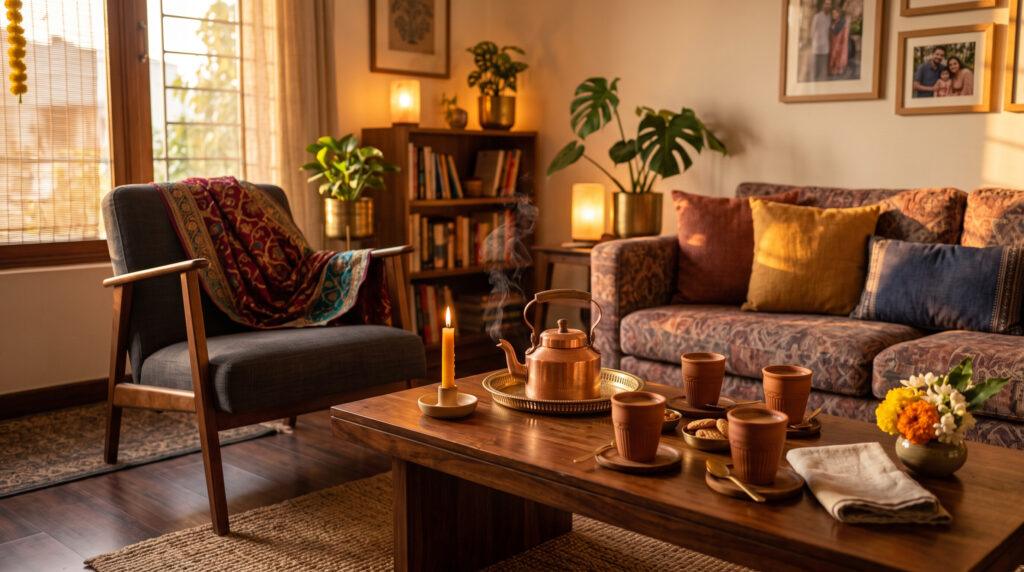
A pot of chai, four kulhads, and two hours on a Saturday afternoon. That is enough. That is where connection lives.
→ Simple celebrations that build connection
The desi hosting philosophy behind every gathering
At Connect-n-Rejuvenate, every guide, every theme, and every resource is built on one belief:
Connection is not something that happens to you. It is something you create — through the deliberate act of gathering, celebrating, and showing up for the people in your life.
The Rooted & Radiant hosting framework — rooted in culture, tradition, and warmth; radiant in modern design and intentional experience — exists because both halves matter equally. The culture gives the gathering its soul. The intention gives it its shape.
You do not have to recreate India in your backyard. You do not have to choose between who you were and who you have become. You get to build something that holds both — a doorway that has learned to hold two worlds at once.
That is the party worth planning. That is the community worth building. And it starts with one gathering — however small, however imperfect, however far from home.
Where to start on Connect-n-Rejuvenate
Whether you are planning your first intentional desi gathering or your fiftieth, here is where to begin:
- How to choose the right desi party theme for your crowd
- The Desi Backyard Carnival — the most multigenerational gathering format
- 10 Indian party themes that blend culture and modern style
- How to host a Raksha Bandhan celebration abroad
- Simple celebrations for everyday connection
Because the most connected version of your life abroad doesn’t happen by accident. It happens one celebration at a time.
Frequently asked questions
Why do desis living abroad often feel disconnected?
Back home, community is the default — connection happens organically through shared spaces, spontaneous visits, and cultural rhythms everyone participates in simultaneously. Abroad, those structures don’t exist. Community has to be built deliberately, which takes more effort than most people expect. The good news is that once you start creating intentional gatherings, the community compounds quickly.
How do desi celebrations help with loneliness?
Celebration creates the conditions that make genuine connection possible — shared focus, shared activity, shared memory. It gives people a reason to gather, a role to play, and a moment to remember. For desis abroad, it also recreates the cultural rhythm that makes belonging feel like home rather than performance.
How do I build a desi community abroad from scratch?
Start smaller than you think necessary. One family over for chai. Two families for Diwali. A backyard gathering for four kids and their parents. Repeated small gatherings build community faster than occasional large ones, because connection compounds over time. Celebration gives you a natural reason to reach out — “come over for Holi” is an easier invitation than “let’s hang out sometime.”
How do I get my children to connect with their desi heritage?
Make it joyful, not instructional. Children connect with culture through experience, not explanation. A Diwali where the diyas are lit and the mithai is made together and the cousins play in the dark with sparklers creates a memory that no classroom lesson can replicate. Let them participate, let them lead one element, and let the gathering be genuinely fun. The meaning follows the memory.
What is the easiest way to start hosting intentional desi gatherings?
Pick the next festival or cultural moment on the calendar and invite two families over. Keep the food simple — one big pot of something, chai, and whatever mithai you can find at the Indian grocery. Focus on one activity rather than a full program. The goal for the first gathering is not perfection. It is showing up. Everything else builds from there.
Leave a Reply