
connect-n-rejuvenate.com · Building Connection
You shared a bedroom, a dinner table, a childhood. Then life took over — in stages, quietly, without either of you realizing it.
This is about the desi sibling bond — how it forms, how it drifts, and why Raksha Bandhan is the one day a year that brings it back. Whether you are celebrating Rakhi in the same city or across an ocean — this is for every adult sibling who has felt the gap growing and has not known how to close it.
You shared a bedroom.
Not by choice. By circumstance. The same four walls, the same ceiling, the same argument every night about who left the light on. You knew the sound of each other’s breathing. You knew which floorboard creaked and how to avoid it coming home late. You knew every mood before a word was spoken because you had been reading each other since before either of you had language for it.
You shared a dinner table where someone was always talking too loudly and someone was always sulking and your mother was always threatening consequences she rarely followed through on. You shared school runs in the back seat of the same car, elbows touching, both of you pretending you were somewhere else.
You shared the ordinary. Which is to say — you shared everything.
That version of your relationship was built not on grand moments but on accumulation. Thousands of ordinary days stacked on top of each other until the result was someone who knew you entirely — not because they tried to, but because they could not avoid it.
The sibling who grew up in the same house as you, knows something about you that nobody else in your adult life will ever know. They know who you were before you became who you are. They know the unfinished version. The version still being formed. That knowledge does not disappear when you grow up and move apart. It just stops being updated.
That is where the drift begins.
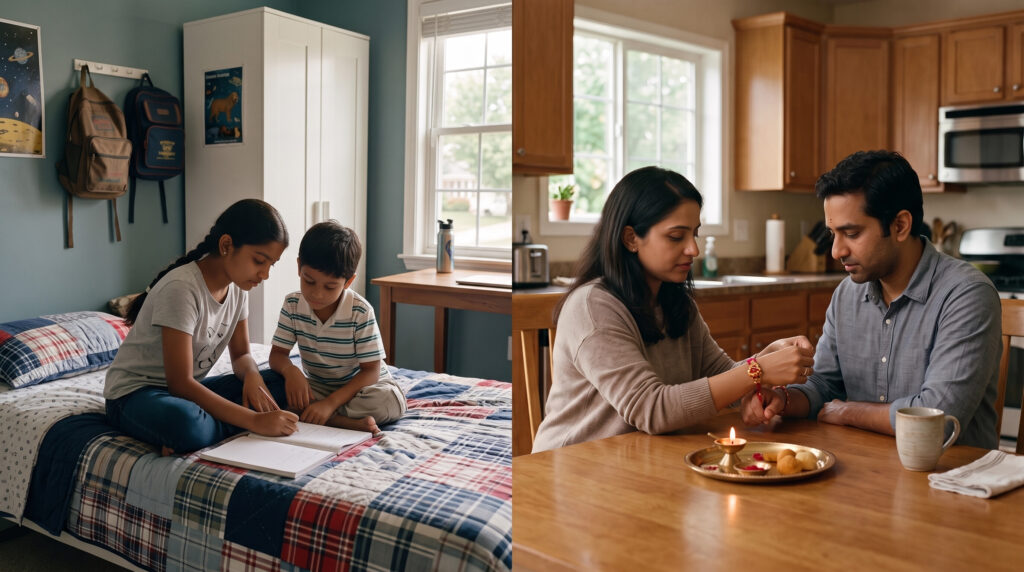
How the Desi Sibling Bond Drifts — Three Stages Every Adult Sibling Recognizes
Nobody decides to drift from their sibling. It is not a choice. It is what happens when life fills every available space and the relationship that needed no maintenance suddenly needs all of it.
It happens in three stages. You may recognise all of them.
Stage One
Moving — the moment the relationship changed shape
One of you left first. University, a job, a marriage, a visa. The bedroom that was shared became one person’s room. The dinner table became smaller. The school run ended.
The relationship did not end. But the container that held it — proximity, shared space, the daily accidental intimacy of living together — was gone. What replaced it was effort. And effort, when you are young and building a new life somewhere new, is the thing you have least of.
You called. Less than you meant to. Visits happened and were wonderful and slightly strange — because you were already becoming different people in different places, and the gap between who you were when you lived together and who you were becoming was just beginning to show.
Stage Two
Marriage and children — each sibling building a separate world
Then came the bigger life. Marriage. Children. The complete restructuring of every hour of every day around new people who needed you entirely.
Your sibling did the same. Their life filled up the way yours did. The calls that were already infrequent became rarer. The visits required more planning. The children — yours and theirs — existed in each other’s lives as photographs and occasional shared dinners where the adults barely talked because the children needed managing.
This is where most people would say things got complicated. But they did not get complicated. They got busy. Complicated implies conflict. This was quieter than that. This was just life, taking up all the space.
Stage Three
Careers and ordinary busyness — the drift that no one notices until it has already happened
The third stage has no dramatic event. No move, no marriage, no milestone. Just the steady accumulation of ordinary days in which your sibling is not present.
You think of them. Of course you do. But thinking of someone and reaching out are different actions, and the gap between them grows when life is full and the time difference is inconvenient and the call requires finding thirty minutes when both of you are free and present simultaneously.
So the call does not happen. And then another week passes. And then you realise it has been two months since you spoke properly and neither of you quite knows how that happened.
That is stage three. The drift that nobody chose. The slow, almost imperceptible movement from someone I speak to to someone I mean to speak to.
If you recognised yourself in any of those stages — you are not doing anything wrong. You are doing what adults do when life takes over. And what you need is not a resolution or a plan.
You need a thread.
The Rakhi — The Thread That Has Always Been There
Raksha Bandhan does not solve the drift.
It interrupts it.
Once a year, on the same lunar date, the festival arrives and says: stop. Stop the busyness. Stop the ordinary forward momentum of your adult life. Stop and look at the person who shared your bedroom and your dinner table and your unfinished childhood self.
Look at them. And tie something between you.
The rakhi is a thread. Small, handmade or bought, tied with varying degrees of ceremony depending on the age of the person tying it and the chaos of the kitchen around them. It is not impressive by itself.
What it does is impressive. The sibling bond and Raksha Bandhan have always belonged to each other — one the relationship, one the annual act of refusing to let it fade. The rakhi makes the invisible visible. It takes the bond that has been running silently in the background of both your lives — through the moves, the marriages, the children, the busyness — and brings it to the surface for one afternoon.
It says: this bond exists. I am marking it. I refuse to let it become something I only remember rather than something I live.
The rakhi is not a symbol of what you used to have. It is a thread connecting who you were to who you are — with your sibling at the other end of it, doing the same. The bond is not in the thread. The bond is in the tying. In the choice, made annually, to reach across however much distance — physical or emotional — and claim each other again.
You remember the year the rakhi arrived in the post three days late because someone miscalculated the delivery time. You remember tying it over a video call at 6am because of the time difference and both of you still half-asleep.
You remember the year you sat at a kitchen table in a country neither of you had imagined living in, and your daughter tied a rakhi on your son’s wrist for the first time, and your son — who had been loudly uninterested in the whole proceedings — went very quiet for a moment.
You remember thinking: this is it. This is the thing. Not the perfect ceremony. Not the grandmother’s kitchen or the cousins or the right words. Just this — the thread, the wrist, the quiet moment before everyone goes back to being loud.
That is Raksha Bandhan. That has always been what it is.
What Raksha Bandhan Is Actually Asking You to Remember About Your Sibling
Raksha Bandhan is not asking you to fix the drift.
It is asking you to acknowledge it — and then to keep going anyway.
The sibling who shared your bedroom is still the person who knows the unfinished version of you. That has not changed. What has changed is the accumulation of ordinary days in which you did not update each other. The relationship is not broken. It is behind. Behind on the ordinary details. Behind on the interior of each other’s lives.
Raksha Bandhan gives you the occasion. Not to fix all of it. To begin.
What the ritual gives you that a phone call cannot
A phone call requires both of you to generate something — conversation, common ground, energy. After a long drift, that generation feels effortful in a way that can make you put the call off for another week.
Raksha Bandhan has a script. You both know what happens and in what order. The thali, the tilak, the thread, the sweet. The ritual carries the interaction. You do not have to produce the warmth. The ceremony produces it for you. And what happens after — the conversation, the memory that surfaces, the thing that gets said that would not have been said without the occasion — is warmer and more honest than any catch-up call because the ceremony has already done the emotional work.
🧧 The specific thing the Rakhi does
When your sibling ties the rakhi on your wrist, something particular happens. You are wearing the relationship. On your body. Visibly. For days after the ceremony, every time you notice the thread — making tea, typing at a desk, helping a child with their homework — you think of the person who tied it.
That is not sentiment. That is how physical objects maintain emotional connection across the ordinary days when connection is not otherwise being actively maintained. The thread does something the video call cannot. It stays.
The Sibling Relationship Nobody Else Can Replace
There is a specific kind of being known that belongs only to siblings.
Your partner knows you as the adult you became. Your friends know you as the person you chose to present. Your children know you as the parent you are performing, more or less successfully, every day.
Your sibling knows who you were before any of that.
They know the tantrum you threw at eight that you have never mentioned to anyone. They know the fear you had that you disguised as bravado. They know the first time something broke your heart and what you looked like afterwards. They know the version of you that existed before you had the language to explain yourself or the self-awareness to manage how you came across.
That knowledge is irreplaceable. No amount of adult intimacy recreates it.
And in the busyness of adult life — the careers, the children, the ordinary forward momentum — that knowledge sits quietly, not being added to, not being updated, but not disappearing either.
Raksha Bandhan is the day you return to it. Not to go backwards. To bring what was forward into what is.
💛 The question worth asking this Raksha Bandhan
After the ceremony. After the sweets. When the children have run off and the adults are still at the table with chai going cold in their cups.
Ask your sibling something you have never asked before.
“What do you remember about us that I have probably forgotten?”
Or: “What is something from our childhood that still stays with you?”
Or simply: “What has this year actually been like for you?”
You do not need to fix the drift in one afternoon. You just need to begin the update. One conversation. One specific question. That is enough to change the quality of the desi sibling relationship for the next twelve months.
Keep Your Sibling Real to Your Children — That Is the Most Important Thing You Can Do Today
Here is the long game.
Your children are watching everything you do with your sibling relationship. They are absorbing, without knowing they are absorbing it, the model of what adult sibling bonds look like. Whether siblings stay close or drift apart. Whether the relationship is maintained or left to chance.
They are also — quietly, incrementally — losing the thread to their own cousins.
The cousins who live abroad, or in another city, or simply in another rhythm of life — they are becoming strangers to your children in the slow way that people become strangers when there is no structure to the connection. Not through conflict. Through nothing. Through the absence of the ordinary that makes people real to each other.
You can stop this. Not with a grand gesture. With the accumulation of small ones.
Three things to do this week — starting today
🌿 Three actions — small enough to do today
01 Tell your children a specific story about your sibling today. Not “your mama/chacha is a good person.” A real story. The time they did something funny. The year something hard happened and they showed up. The childhood detail that still makes you laugh. A specific story with a beginning and an end. Tell it at dinner, in the car, at bedtime. Children who hear stories about their relatives regularly grow up with a felt sense of those relatives as real people — not photographs and video calls, but actual humans with histories and personalities and stakes in the child’s life.
02 Let your children call their cousin — not as an event, but as an ordinary thing. Five minutes. No agenda. Just two children talking. The cousin bond is built in exactly the same way the sibling bond was built — through the accumulation of ordinary contact. One five-minute call a month adds up. One a year does not. Make it ordinary rather than occasional and it becomes the foundation of a relationship that will outlast you.
03 Use Raksha Bandhan this year as the official beginning of the cousin bond. Your child ties a rakhi for their cousin — in person or over a video call or posted in advance. The ceremony gives the relationship a name and a marker. Cousins who have celebrated Raksha Bandhan together have a shared reference point. Something to build from. It does not require the cousins to be close yet. It just requires both families to show up once, annually, and give the relationship a ceremony worth remembering.
The sibling you are describing to your children today is the relative your children will reach toward as adults. The stories you tell are the threads you are laying. You are not just maintaining your own desi sibling bond — you are building your children’s cousin bonds from the ground up. Both happen the same way. Through the ordinary act of making someone real.
Why Raksha Bandhan Once a Year Is Enough — If It Actually Happens
Once a year sounds insufficient.
It is not. What once a year provides — when it is taken seriously, when it is not absorbed into a larger gathering, when it is given its own time and its own ceremony — is the annual interruption that every adult sibling relationship needs.
Not a solution. Not a substitute for the ordinary contact that should happen between festivals. An anchor. The fixed point in the year that the relationship is measured against. The moment where both of you stop and ask — quietly, without needing to ask it directly — are we okay? Are we still choosing this?
The answer, at a well-held Raksha Bandhan, is always yes.
Not because the ceremony is magic. Because the act of showing up for the ceremony — of ordering the rakhi, setting the thali, sitting beside your sibling and tying the thread — is itself the answer. You showed up. The relationship is alive. The drift has not won.
🪔 What Raksha Bandhan is actually saying — every year
Every year, the festival arrives and says the same thing to every sibling who celebrates it:
You still have each other. The childhood you shared is not just memory — it is foundation. The desi sibling bond you built in ordinary days is still here, underneath all the adult life that has grown on top of it. Come back to it. Tie the Rakhi. Eat the sweet. Say the thing.
That is what Raksha Bandhan is. Not a festival about protection or obligations.
A festival about the bond. About choosing, once a year, to make the invisible visible.
About refusing — together, deliberately, with a thread tied on a wrist — to let the drift win.
The Thread Is Still There
The sibling who shared your bedroom is still the person who knows the unfinished version of you.
Life took over. In stages, quietly, without either of you choosing it. The moves, the marriages, the children, the careers. Each one entirely reasonable. Each one taking you a little further from the dinner table arguments and the school runs and the ordinary accumulation of days that made you who you are to each other.
But the thread is still there.
It has been there every Raksha Bandhan, whether you marked it deliberately or treated it as background. It is there in the phone call you keep meaning to make. It is there in the way you still think of your sibling when something good happens and you want to tell someone who knew you before you became someone worth telling.
This Raksha Bandhan — mark it deliberately.
Set the thali. Tie the thread. Say the specific thing. Tell your children a story about their aunt or uncle that makes that person real in a way a photograph never will.
And then, in the ordinary week after the festival, when the rakhi is still on the wrist and the mithai tin is still on the counter — make the call you have been meaning to make. Not to catch up. To continue.
The desi sibling bond does not need to be rebuilt. It needs to be returned to. Raksha Bandhan is how you find your way back.
📅 Raksha Bandhan 2026 — US date: Thursday August 27.
👉Stay Close — Even From Far Away
Festival ideas, cultural meaning, and connection tools delivered before every desi celebration. Built for families who are holding traditions across distances that were never supposed to be this far.
No spam. Unsubscribe any time. Only festival content.
Continue the Raksha Bandhan Journey
🫂 Feel it → The Sibling Bond — This article
The childhood, the drift, the thread that ties you back together every year.
🪔 Understand it → What is Raksha Bandhan? The Meaning Behind the Rakhi
The origin stories, the meaning layers, and how to explain it to children who grew up abroad.
🎉 Plan it → How to Host a Raksha Bandhan Celebration Abroad
The themes, the decor, the food, the activities. Everything you need to host this year.
Filed under: Building Connection · connect-n-rejuvenate.com
Leave a Reply