
connect-n-rejuvenate.com · Roots & Rituals
Not the textbook version. The real one — for parents who want their children to feel what this festival means, not just know what it is.
📅 Raksha Bandhan 2026: US, UK & Canada celebrate Thursday August 27. India & Australia celebrate Friday August 28. The same ceremony, the same thread — just a timezone apart.
If you have ever searched what is Raksha Bandhan and come away with an answer that felt incomplete — you are not alone.
The standard explanation goes like this: Raksha Bandhan is when a sister ties a rakhi on her brother’s wrist, prays for his long life, and he promises to protect her.
This is true. But the Rakhi meaning goes deeper than brother-sister love — especially if you are trying to explain it to a child who grew up in the United States and is quietly wondering what “protection” means when her brother lives in Bengaluru and she lives in US.
This guide gives you the full Raksha Bandhan meaning — the origin stories in plain language, what the Rakhi actually symbolizes, and how to explain it to kids raised abroad in a way that makes them feel seen, not just know the facts.
Raksha Bandhan is not a festival about gender roles or obligatory gifts. It is a festival about the specific kind of love that shows up without being asked — that says, without ceremony: I am in your corner. Whatever comes, I am in your corner. The Rakhi is the thread that makes that promise visible.
That is the version worth teaching your children. This article gives you the language to do it.
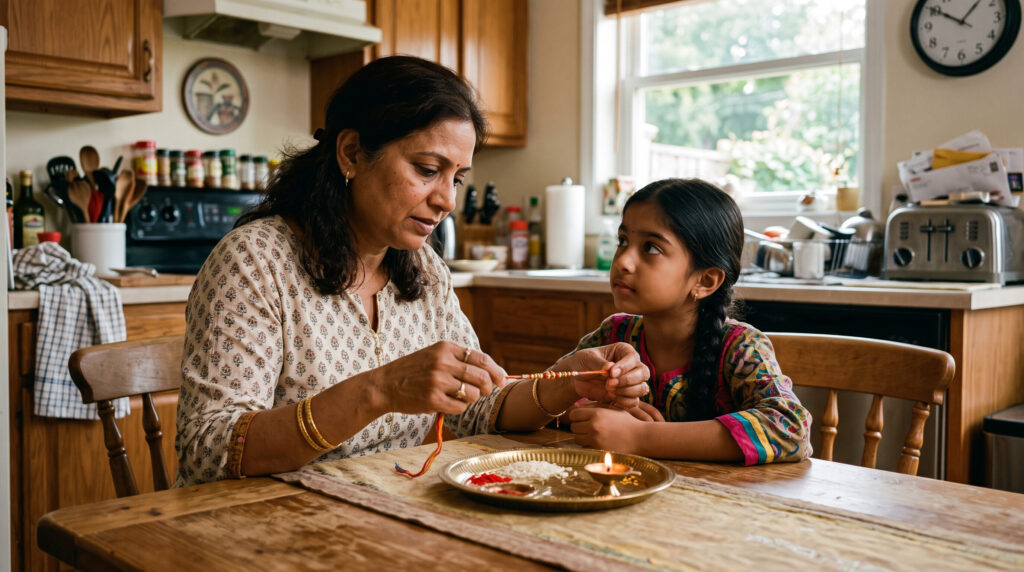
What Does Raksha Bandhan Mean? Start With the Words
Raksha means protection.
Bandhan means bond.
Put them together: the bond of protection.
Not a one-sided bond. Not “I protect you.” A bond — meaning it runs both ways, it requires both people, and it holds something between them rather than just from one to the other.
When a sister ties a rakhi, she is not asking to be protected. She is creating a bond. She is saying: I am tying us together. I am marking us as people who look out for each other. You are mine and I am yours.
The brother’s gift — and his promise — is his response to being claimed in that way. It is not payment. It is recognition. Yes. I am yours. And you are mine.
💬 How to explain this to your child — in plain words
“The word raksha means protection and bandhan means bond. So Raksha Bandhan means: we are bonded to protect each other. When your sister ties the rakhi on your wrist, she is not asking you to be her bodyguard. She is saying: I am choosing you. I am tying us together. And you are promising to choose her back.”
The Origin Story of Raksha Bandhan — In Plain Language
Raksha Bandhan is not one story. It is many stories that all arrive at the same truth.
Here are three of them — each one different, each one saying the same thing.
📖 Story 1 — Draupadi and Krishna
Krishna cut his finger on a sugarcane. Draupadi was standing nearby. Without thinking, she tore a strip from her own sari and wrapped it around his wound.
That was it. No prayer. No ceremony. Just a woman who saw someone she cared about hurting and did the immediate, instinctive thing.
Krishna never forgot. Years later, when Draupadi needed protection more than anyone had ever needed it, Krishna showed up. Not because he owed her. Because that is what the bond means.
For your children: Protection does not always look like strength. Sometimes it looks like tearing your own sari to bind someone’s wound. And the people who see you do that — they remember forever.
📖 Story 2 — Indrani and Indra
Before a great battle, Indrani tied a sacred thread on Indra’s wrist and prayed for his safety. He went into battle. He came home.
The thread was not a magic charm. It was a visible reminder that someone was waiting for him. That he had been prayed for. That his return mattered to someone specific.
For your children: Sometimes the most powerful thing you can give someone is not advice or money or strength. It is proof that you thought of them. That you prayed for them. That they are not alone in whatever they are walking into.
📖 Story 3 — Goddess Lakshmi and King Bali
Goddess Lakshmi tied a rakhi on King Bali’s wrist — not because he was her brother, but because she wanted to establish a bond of protection with him. Bali, honoured by the gesture, vowed to protect her.
This story matters more than the others for one reason: Lakshmi and Bali were not siblings. The rakhi crossed the boundary of family into something chosen.
For your children: The bond of Raksha Bandhan does not belong only to biology. It belongs to the people we choose to be responsible for.
What Does a Rakhi Symbolise? Beyond Brother-Sister Love
Ask most people what a rakhi means and they will say: it is a symbol of the brother-sister bond.
That is true. But it is also like saying chai is just hot water with milk. Technically accurate. Missing everything that matters.
The rakhi carries several layers of meaning simultaneously — and the layer that resonates most depends on who you are and what you need it to mean in your particular life.
Layer 1
A visible mark of chosen responsibility
The rakhi is tied on the wrist — the most visible part of the body. It is meant to be seen. By the person wearing it and by everyone who encounters them. It is a public declaration: I am in a bond of protection with someone. I have been claimed. I have claimed someone back.
In a world where most love is invisible, the rakhi makes one relationship literally visible for the duration of its wear.
Layer 2
Reciprocal care — not one-directional protection
The older framing of Raksha Bandhan placed all the protection with the brother. The sister received. The brother gave.
The truer and older meaning — the one the stories actually tell — is reciprocal. Draupadi gave first. Indrani gave first. Lakshmi gave first. In each story, the woman initiates the bond and the man responds to being honoured by it.
The rakhi is the sister’s gift. The promise is the brother’s response. Both are acts of care. Neither is lesser.
Layer 3
The thread as a container for prayer
When a sister ties a rakhi, she prays. For her brother’s health, his safety, his long life. She pours something of herself into the knot she ties.
The thread holds that prayer. The brother carries it on his wrist — not just a decoration, but proof that someone specific thought of him with enough love to ask the universe on his behalf.
In a diaspora life full of distance and missing and celebration over video call — that prayer is not small. It is everything.
Layer 4
The annual renewal of a bond
Raksha Bandhan happens every year on the same lunar date. Not because sibling love needs to be renewed — but because taking the time, once a year, to make the invisible visible is what keeps bonds alive across the ordinary seasons of adult life.
Siblings grow up and apart. They build separate lives. They get busy. The annual ritual is not a reminder that the bond exists. It is the act that keeps it active.
Live AbroadRaksha Bandhan Meaning for NRI and Diaspora Families
Here is the thing nobody writes about:
Raksha Bandhan was designed for proximity. For siblings in the same house, the same gully, the same city. The brother sat down. The sister tied the rakhi. They ate sweets together. Then they went back to their ordinary lives — which were adjacent.
None of that architecture holds when you are in aboard and your brother is in Pune.
So what does the festival mean when the original container — proximity, shared space, the gully, the grandmother’s kitchen — is gone?
It means more. Not less.
When the ritual is easy, it is background. When it is hard — when it requires international postage and timezone calculations and tying a rakhi to a photograph frame while your brother watches on a screen — it becomes deliberate. And deliberate love is the most powerful kind there is.
What protection means when your brother is in another country
Protection used to mean physical presence. Now it means:
- The call he makes when something goes wrong, without waiting to be asked
- The voice note she sends when she knows he is having a hard week
- The fact that when something good happens, he is the first person she thinks to tell
- The money he sends when she needs it, quietly, without making it complicated
- The fact that she knows — across ten thousand miles — that he is in her corner
Protection was never really about physical safety. It was always about the certainty of being someone’s priority. The distance changes the form. It does not change the substance.
What to tell your children when they ask why you tie a rakhi to a photograph
💬 How to explain this to your child — in plain words
“Your mama/chacha/bhai is far away. We cannot tie the rakhi on his wrist today. So we tie it to his photograph — because the bond does not live in geography. It lives in us. The thread is just the way we make it visible. The rakhi says: we are thinking of you. We are praying for you. We have not forgotten what you mean to us. He knows. Distance cannot change that.”
Can Anyone Tie a Rakhi? What If There Is No Brother?
This is the question that quietly sits in the room at every Raksha Bandhan celebration — and is almost never asked out loud.
What if you are a desi woman abroad with no brother? Or whose brother is estranged? Or whose brother has passed away? Or who has daughters and no sons, and watches other families celebrate a festival that seems to have no space for her children?
The traditional framing of Raksha Bandhan excludes you from your own festival.
The actual meaning of Raksha Bandhan does not.
Go back to the Lakshmi and Bali story. The rakhi crossed family lines into chosen bonds. Go back to the word itself — bandhan, bond. It does not say sibling bond. It says bond.
The rakhi has always been bigger than biology. The tradition narrowed it. You are allowed to reclaim the original width.
Who can tie a rakhi — the full picture
- Cousins — this is already common across much of the subcontinent. The bhai-behen bond extends naturally to cousins in families where cousins were raised like siblings.
- Close family friends — the dost who has been in the family for thirty years, who showed up when the brother could not, who your child calls chacha though there is no blood between you.
- Friends who have become family — the diaspora creates chosen family at a rate the subcontinent never needed to. These bonds are real. The rakhi is for them too.
- A daughter tying a rakhi on her mother — protection runs in every direction. The bond is the point, not the direction it travels.
- Tying a rakhi to a photograph of someone who has passed — not a workaround. Not a lesser version. A genuine act of ceremony for a bond that does not end with death.
🌿 The permission your children need
“Tell them: You get to choose who you tie a rakhi to. The only rule is that you mean it. That the person on the other end of this thread is someone you would show up for — and someone you believe would show up for you. That is a rakhi bond. It does not need to be a sibling. It needs to be true.”
Raksha Bandhan in 2026 — The Modern Meaning
Raksha Bandhan is 3,500 years old, give or take.
It has survived empires, migrations, Partition, and the diaspora. It has been celebrated in gullies and in suburban American living rooms with furniture pushed to the side. It has adapted to every container it has been placed in.
The version your children celebrate in abroad is not a diminished version of the original. It is the latest chapter of a tradition that has always changed to survive — and has always kept its essential truth while doing so.
That essential truth is this:
Once a year, we stop and make visible the bonds that hold us. We tie a thread. We say the prayer. We eat the sweet. We remind each other — and ourselves — that we are not alone in this. Whatever this is.
That truth does not require a gully or a grandmother or the same country. It requires only the thread and the intention. Both of which travel anywhere.
Three questions to ask your children on Raksha Bandhan
These work better than any explanation. They invite children into the meaning rather than delivering it to them.
- “Who would you call first if something went wrong?” — That person is your Raksha Bandhan relationship, whether the ritual recognises it or not.
- “Who do you think of when something good happens and you want to tell someone?” — The same answer. The bond and its direction are already there. The rakhi just names it.
- “What does it mean to protect someone you love when you are far away from them?” — Let your child answer. Their answer will surprise you. Children who grow up in the diaspora have thought about distance and love more deeply than any curriculum has ever asked them to.
The Rakhi Mantra — The Words of the Ceremony
The traditional mantra recited when tying the rakhi:
🪔 The Raksha Bandhan mantra
“Yena baddho balee raajaa daanavendro mahaabalah
Tena twaam anubadhnaami rakshe maa chala maa chala”
In plain English: “I bind you with that same thread with which the mighty King Bali was bound. O raksha, be firm, do not waver.”
You do not need to use the Sanskrit. You can say it in Hindi, in English, or in your own words. The mantra is the container for the intention. What matters is that the intention is real.
💬 How to explain this to your child — in plain words
A simpler version for children who are learning:
“I tie this thread to say: I am with you. I pray for your happiness and safety. I am your family — not just by blood, but by choice. This thread is my promise.”
Have your child say this in their own words before they tie the rakhi. The meaning lands in the saying of it, not the perfection of the words.
This Is What You Are Passing On
When your child ties a rakhi for the first time and does not fully understand what they are doing — that is not a failure of the tradition. That is the tradition working exactly as it always has.
Understanding comes later. First comes the action, the thread, the sweet, the prayer. Years of this — repeated annually, adapted for the life you are actually living — builds a felt sense of what the festival means that no explanation can give.
Your children will understand Raksha Bandhan the way they understand most things about being desi abroad: slowly, cumulatively, in the gap between what they were told and what they eventually feel.
Your job is not to make them understand it immediately.
Your job is to keep doing it — imperfectly, in a you living room, with a rakhi ordered from Amazon and a video call to a brother in Pune — until one year they look up from the thread and understand completely.
That year will come.
Keep tying the rakhi. The meaning catches up.
📅 Raksha Bandhan 2026 — US date: Thursday August 27.
Continue the Raksha Bandhan Journey
🪔 Understand it → What Raksha Bandhan Actually Means (This article)
The origin stories, the meaning layers, and how to explain it to children who grew up abroad. — You are here
🎉 Plan it → How to Host a Raksha Bandhan Celebration Abroad
The themes, the decor, the food, the activities. Everything you need to host this year.
🫂 Feel it → The Sibling Bond Nobody Talks About in the Diaspora
For the families celebrating Rakhi with an ocean between them.
Leave a Reply